
The Face of the Future: GravityXR Challenges Apple’s ‘EyeSight’ with High-Fidelity Reverse Passthrough
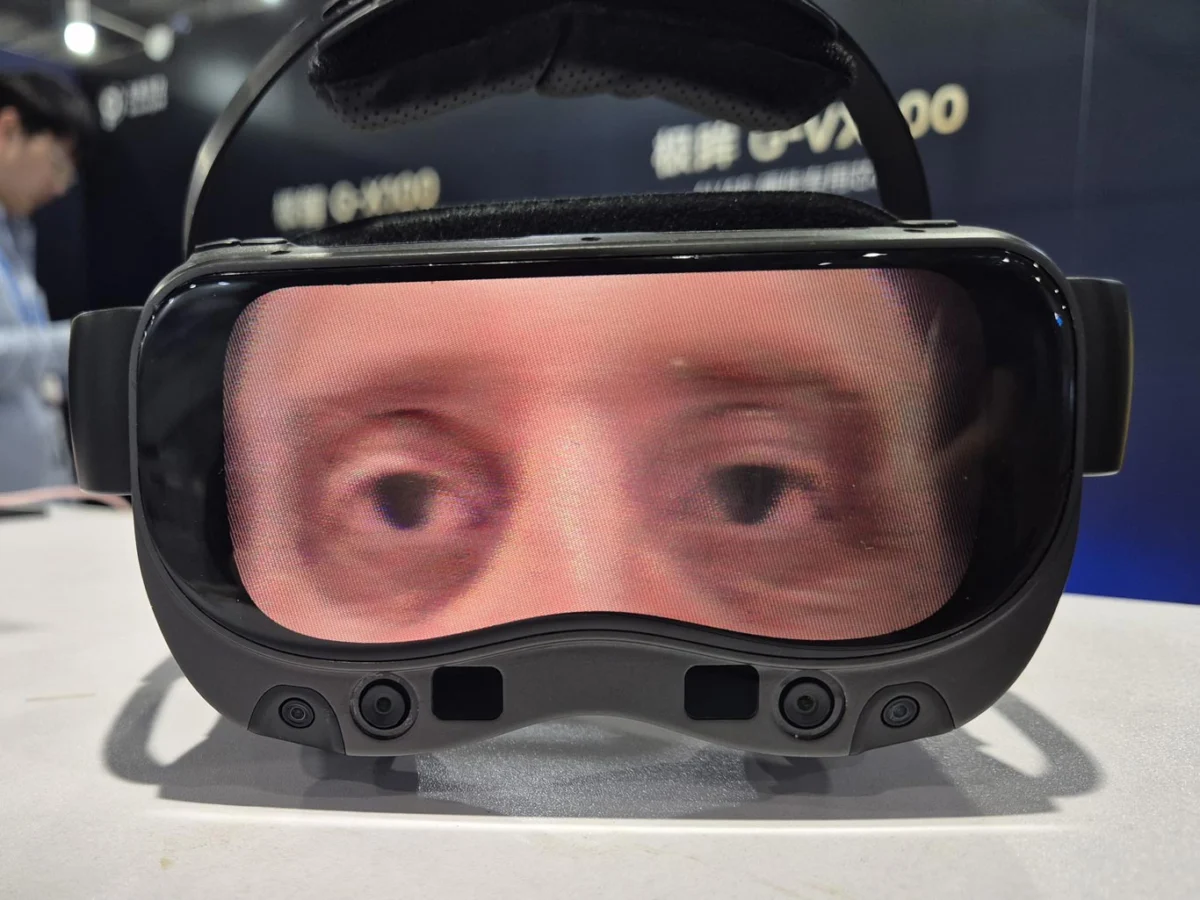
SHANGHAI — In the rapidly evolving landscape of spatial computing, the "isolation problem"—the physical and social barrier created by wearing a bulky headset—remains one of the industry’s most significant hurdles. While Apple attempted to bridge this gap with the "EyeSight" feature on the Vision Pro, the results were met with mixed reviews due to low resolution and a dim, ghostly appearance.
However, at the recent VR AR Expo China, a new contender emerged. GravityXR, a specialized semiconductor firm, demonstrated a breakthrough in "reverse passthrough" technology. Utilizing their dedicated EB-100 chip, the company showcased a system capable of projecting a high-resolution, depth-accurate representation of a user’s eyes onto the exterior of a Mixed Reality (MR) headset. The demonstration suggests that the future of social MR may depend not on software tricks, but on dedicated silicon designed to humanize the machine.
Main Facts: Breaking the Glass Barrier
Reverse passthrough is a hardware and software solution that renders a digital twin of the user’s upper face on an external-facing display. The goal is to allow bystanders to maintain eye contact with the headset wearer, facilitating a more natural social environment.

The GravityXR solution rests on three pillars:
- The EB-100 Chip: A dedicated processor designed specifically to handle the heavy lifting of reverse passthrough and facial rendering. By offloading these tasks, the headset’s primary processor can remain dedicated to environment tracking and application performance.
- G-X100-M0 Reference Design: A high-end MR headset prototype that integrates eye-tracking sensors and an external high-resolution display.
- High-Fidelity Biometric Mapping: Unlike the blurred, generic representations seen in current consumer products, GravityXR’s system uses a 3D depth scan of the individual user to create a photorealistic model.
The result is a visual output that is significantly crisper than Apple’s EyeSight, offering what the company describes as "apparent depth"—a trick of optics that makes the eyes appear to sit inches behind the glass, exactly where they would be in physical space.
Chronology: From Concept to Showfloor
The path to this demonstration began several days prior to the VR AR Expo, when industry analysts and media partners were invited to GravityXR’s headquarters. During these initial briefings, the company revealed its roadmap for specialized XR silicon, emphasizing that the "isolation" of VR could only be solved by making the user’s expressions visible in real-time.

Phase 1: The Capture
On the showfloor in Shanghai, the process began with biometric data acquisition. Using a specialized smartphone application equipped with depth sensors, GravityXR engineers conducted a 360-degree photogrammetric scan of the subject’s face. This 2-3 second video capture recorded the unique geometry of the brow, eyes, and nasal bridge.
Phase 2: Model Generation
This raw data was fed into a localized processing system. Over several minutes, the software synthesized the depth data and textures into a rigged 3D model. This model was then optimized for the EB-100 chip and uploaded directly to the G-X100-M0 headset’s internal storage.
Phase 3: Real-Time Synchronization
Once the user donned the headset, the internal eye-tracking cameras began mapped the user’s pupils and eyelid movements. The EB-100 chip then translated these movements onto the 3D model, projecting the result onto the external screen with near-zero latency.

Supporting Data: Technical Specifications and Performance
The technical superiority of the GravityXR approach over existing solutions lies in its specialized hardware architecture.
The EB-100 Advantage
In traditional XR architectures, rendering an external face model would consume roughly 15-20% of the main SoC’s (System on a Chip) resources. GravityXR’s EB-100 acts as a "co-processor," handling:
- Perspective Correction: Ensuring the eyes look correct from various viewing angles.
- Dynamic Lighting: Adjusting the brightness and shadows of the digital eyes to match the external room lighting.
- Latency Mitigation: Reducing the "lag" between a user’s real blink and the digital representation.
Comparison: GravityXR vs. Apple EyeSight
| Feature | Apple EyeSight (Vision Pro) | GravityXR EB-100 System |
|---|---|---|
| Display Clarity | Low-resolution, translucent/blurry | High-resolution, photorealistic |
| Depth Perception | Limited lenticular effect | High "Apparent Depth" optics |
| Processing | Integrated into M2/R1 chips | Dedicated EB-100 Silicon |
| Setup Process | Persona-based (Software) | 3D Depth Scan (Hardware/App) |
The GravityXR system also addresses the "vergence-accommodation conflict" for the bystander. By using a specialized display layer, the eyes do not appear "pasted" onto the front glass; they appear to be recessed within the device, maintaining the correct anatomical distance from the bridge of the nose.

Official Responses and Market Positioning
While GravityXR has not yet announced a consumer-facing headset of its own, company representatives at the Expo emphasized their role as a Tier-1 supplier. The G-X100-M0 is a "reference design," intended to show companies like Meta, Pico, or Samsung what is possible when using GravityXR silicon.
"The challenge of reverse passthrough is not just showing a picture; it is about maintaining the human connection," a company spokesperson noted during the demonstration. "By providing a dedicated chip, we allow manufacturers to include this feature without sacrificing the battery life or the frame rate of the actual MR experience."
Industry analysts suggest that GravityXR is positioning itself to solve the "Uncanny Valley" problem that has haunted facial reconstruction in tech. However, the company also acknowledged the inherent risks. When the eye-tracking misaligns even by a few millimeters, the human brain perceives the image as "disturbing" or "mutated." GravityXR’s current stance is that high-fidelity hardware is the only way to eventually move past this discomfort.

Implications: The Uncanny Valley and the Future of Social XR
The implications of GravityXR’s demonstration are twofold: they represent a massive leap in technical capability and a significant psychological challenge.
The Uncanny Valley Threshold
The most striking takeaway from the Shanghai demonstration was the "Frankenstein Effect." When the system works perfectly, it is a marvel of engineering that makes the headset feel invisible. However, the "Uncanny Valley"—the dip in human emotional response when a replica looks almost, but not quite, human—is deeper in reverse passthrough than in almost any other medium.
Minor glitches, such as:

- Asynchronous Eye Movement: One pupil moving faster than the other.
- Scale Discrepancies: The digital eyes appearing slightly larger than natural proportions.
- Eyelid Lag: A "drooping" effect where the digital eyelid fails to keep up with the physical one.
These issues can turn a tool for connection into a source of social discomfort. This explains Apple’s conservative approach with EyeSight; by blurring the image, Apple effectively avoids the Uncanny Valley by staying firmly in the "stylized" camp. GravityXR is taking the riskier path toward "hyper-realism."
Privacy and Biometric Identity
The requirement for a 3D depth scan raises new questions regarding biometric data. As reverse passthrough becomes more realistic, the data required to power it becomes more sensitive. The prospect of "trapping a soul in a device"—as one tester described seeing his own eyes on another person’s face—highlights a future where digital facial identities could be swapped or misused.
The Accessory vs. Integrated Debate
Given the added weight, cost, and complexity of the external display and dedicated chip, industry experts are debating whether reverse passthrough should be a standard feature. GravityXR’s modular approach suggests a future where this could be an "optional accessory" for professional users—doctors, educators, or frontline workers—who require high-fidelity social presence, while remaining absent from entry-level gaming headsets.

Conclusion
GravityXR has successfully demonstrated that the "brick on the face" era of VR may be coming to an end. By proving that high-resolution, depth-accurate reverse passthrough is technically feasible through dedicated silicon, they have set a new benchmark for the industry. However, the transition from a "cool and disturbing" prototype to a seamless social tool will require perfecting the nuances of human expression. For now, the eyes may be the window to the soul, but in the world of Mixed Reality, they are the next great frontier for the semiconductor industry.



Leave a Comment