
The Frontline Revolution: Why Mitel is Betting on Voice-First, Edge-Driven Communication
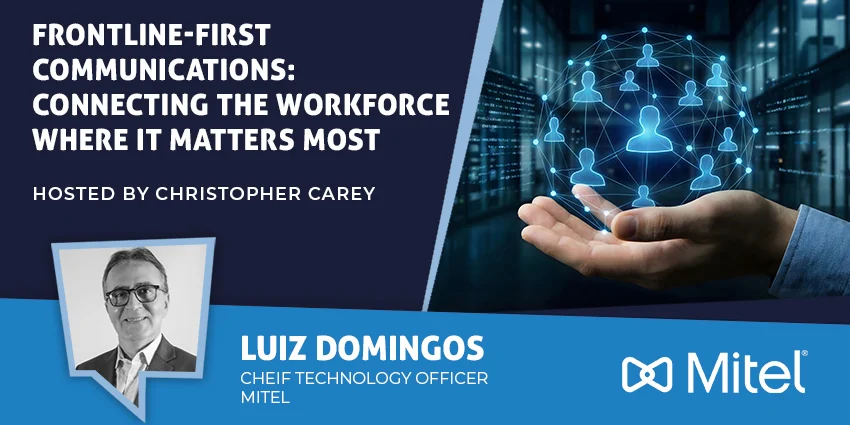
In the modern enterprise landscape, a quiet but profound shift is occurring. For decades, the "Unified Communications" (UC) industry focused almost exclusively on the knowledge worker—the office-bound professional with a laptop, a high-speed fiber connection, and a swivel chair. However, as the digital transformation of the global economy matures, the spotlight is shifting toward the 80% of the global workforce that does not sit behind a desk: the frontline workers.
In a recent comprehensive interview, Luiz Domingos, Chief Technology Officer at Mitel, outlined a compelling vision for the future of operational infrastructure. He argues that the "one-size-fits-all" approach to corporate communications is not just inefficient—it is becoming a liability. For industries ranging from healthcare and hospitality to manufacturing and emergency services, the next era of productivity will be defined by "frontline-first" and "voice-first" technologies.
Main Facts: The Shift from Generic UC to Specialized Infrastructure
The core of Luiz Domingos’ argument rests on a simple realization: the communication needs of a nurse in a high-pressure ER, a technician on a remote oil rig, or a floor manager in a sprawling warehouse are fundamentally different from those of a marketing executive in an office.
The End of "One-Size-Fits-All"
For years, organizations attempted to force frontline workers into the same software ecosystems used by management. This often meant clunky mobile versions of desktop apps that required two hands to operate and constant visual attention. Domingos asserts that this era is ending. Organizations are now recognizing that frontline workers require asymmetric communication tools—systems designed for mobility, durability, and, most importantly, hands-free operation.
Voice as the Primary Interface
While the office world has become obsessed with video conferencing and persistent chat, the frontline is seeing a massive resurgence in voice. Domingos highlights that voice remains the fastest, most natural way to relay mission-critical information when a worker’s eyes and hands are occupied. By making voice the "interface of choice," companies can reduce cognitive load and improve safety.
Embedded and Real-Time
Communication is no longer a standalone app; it is becoming "embedded." This means integrating voice and messaging directly into the workflows and hardware that workers already use—be it a handheld scanner, a medical device, or a ruggedized tablet. When communication is embedded, it ceases to be a distraction and starts to function as essential operational infrastructure.
Chronology: The Evolution of Frontline Connectivity
To understand where we are going, we must look at how frontline communication has evolved over the last three decades.
Phase 1: The Analog Era (1990s – Early 2000s)
In this phase, frontline communication was siloed. Security used two-way radios (LMR), while the back office used traditional PBX desk phones. There was virtually no interoperability between the two. If a warehouse worker needed to reach a manager, they often had to physically find them or use a noisy overhead paging system.
Phase 2: The Mobile Patchwork (2010s)
As smartphones became ubiquitous, organizations began allowing "Bring Your Own Device" (BYOD) or providing basic mobile handsets. However, the software was often a consumer-grade messaging app (like WhatsApp) or a generic enterprise tool not optimized for the environment. This led to "shadow IT" and significant security vulnerabilities, as sensitive operational data moved across unmanaged channels.
Phase 3: The Integration Surge (2020 – 2023)
The COVID-19 pandemic acted as a massive catalyst. Suddenly, the "essential worker" was the center of the economy. Organizations scrambled to provide better connectivity, but the rush led to the "biggest mistakes" Domingos mentions: over-complicating the user experience and failing to account for the unique physical environments of the frontline.
Phase 4: The Intelligent Edge (2024 and Beyond)
We are now entering the fourth phase, where AI, Edge computing, and Hybrid architectures converge. This is the era Domingos is championing—one where the network is resilient enough to handle a total internet outage while still providing AI-driven insights to the worker on the ground.
Supporting Data: The High Stakes of the Frontline Gap
The move toward specialized communication is driven by hard data regarding the "deskless" workforce.
- The Workforce Ratio: According to research from Emergence Capital, 80% of the global workforce (approximately 2.7 billion people) is deskless. Yet, historically, only 1% of enterprise software venture capital has been directed toward tools for these workers.
- The Productivity Leak: Studies suggest that frontline workers lose an average of 3 to 4 hours per week due to inefficient communication or the need to hunt down information that isn’t available at their point of work.
- The Safety Factor: In industrial sectors, 70% of workplace accidents are attributed to human error, often exacerbated by poor communication or a lack of real-time situational awareness.
- Resiliency Requirements: For mission-critical sectors like healthcare, a "cloud-only" communication strategy presents a risk. Data shows that even 99.9% uptime (the industry standard) results in nearly 9 hours of downtime per year—a duration that is unacceptable for a hospital or emergency response center.
Official Responses: Insights from Luiz Domingos
During the interview, Luiz Domingos provided deep technical and strategic insights into how Mitel is addressing these challenges. His responses centered on three pillars: AI Value, Hybrid Architecture, and Security.
On the Practical Value of AI
"AI shouldn’t be a buzzword for the frontline; it must be a utility," Domingos suggests. He explains that for a worker in a noisy factory, AI’s greatest value isn’t a generative text bot, but rather AI-powered noise cancellation that can isolate a human voice from heavy machinery. He also points to "Voice-to-Action" capabilities, where a worker can give a verbal command to log a maintenance issue or check inventory without ever touching a screen.
On Hybrid and Edge Architecture
One of the most technical aspects of Domingos’ vision is the move toward the Edge. "In mission-critical environments, you cannot rely solely on the public cloud," he notes. By utilizing a hybrid architecture, Mitel ensures that local communication stays live even if the wider internet fails. This "survivability" is crucial for environments like mines, ships, or hospitals where a loss of communication can lead to catastrophic outcomes.
On Avoiding Modernization Mistakes
When asked about the pitfalls of modernizing, Domingos was blunt: "The biggest mistake is ignoring the end-user’s physical reality." He notes that many IT departments buy software based on a feature list that looks good in a boardroom but fails in the field. He advocates for a "user-centric" design approach where the technology adapts to the worker’s gloves, their protective gear, and their need for rapid, sub-second response times.
Implications: The Future of the Connected Workforce
The shift toward a voice-first, frontline-first strategy carries significant implications for the future of global industry.
1. Operational Resilience as a Competitive Advantage
Companies that adopt resilient, hybrid communication infrastructures will be better equipped to handle crises—be they cyberattacks, natural disasters, or simple ISP failures. In a world of "just-in-time" supply chains, the ability to maintain communication under pressure is a massive competitive advantage.
2. Employee Retention and Safety
The frontline workforce is currently facing a global labor shortage. By providing workers with tools that actually make their jobs easier—and safer—organizations can improve morale and reduce turnover. A worker who feels supported by their technology is more likely to remain in their role.
3. Data-Driven Insights from the Field
By digitizing voice communications and integrating them into the enterprise stack, organizations can finally capture data from the "edge." AI can analyze these voice streams (with proper privacy safeguards) to identify recurring operational bottlenecks or safety hazards that were previously invisible to management.
4. The Sovereignty of Data
As geopolitical tensions rise and data privacy laws (like GDPR) tighten, the "Edge" and "Hybrid" models Domingos discusses offer a way for organizations to maintain digital sovereignty. Keeping critical operational data on-site or within a controlled hybrid cloud ensures that sensitive information remains secure and compliant with local regulations.
Conclusion
The insights shared by Mitel CTO Luiz Domingos signal a "coming of age" for frontline technology. For too long, the people responsible for the physical execution of the world’s economy have been an afterthought in the digital revolution. By pivoting to a voice-first, resilient, and specialized communication infrastructure, the enterprise is finally bridging the gap between the office and the field.
As Domingos suggests, the goal is not just to "connect" workers, but to empower them with an operational nervous system that is as fast, flexible, and reliable as the work they do. In the high-stakes world of the frontline, communication isn’t just a tool—it’s a lifeline.



Leave a Comment