
Unveiling the Blueprint of Immersion: A Deep Dive into Dream Pod 9’s Heavy Gear Blueprint File
Main Facts
Dream Pod 9, a name synonymous with visual excellence and meticulously crafted universes, has long captivated the imagination of tabletop gamers and science fiction enthusiasts alike. Renowned for its trio of iconic game lines—Heavy Gear, Jovian Chronicles, and Tribe 8—the publisher established an unparalleled reputation for high-quality artwork and immersive world-building. Among its more innovative supplementary offerings, the "blueprint files" emerged as a unique product designed to transport players deeper into the intricate mechanics of their fictional worlds. The Heavy Gear Blueprint File, originally reviewed on February 5th, 2002, stands as a prime example of this innovative approach, providing a tangible connection to the advanced machinery that defines the game’s setting.
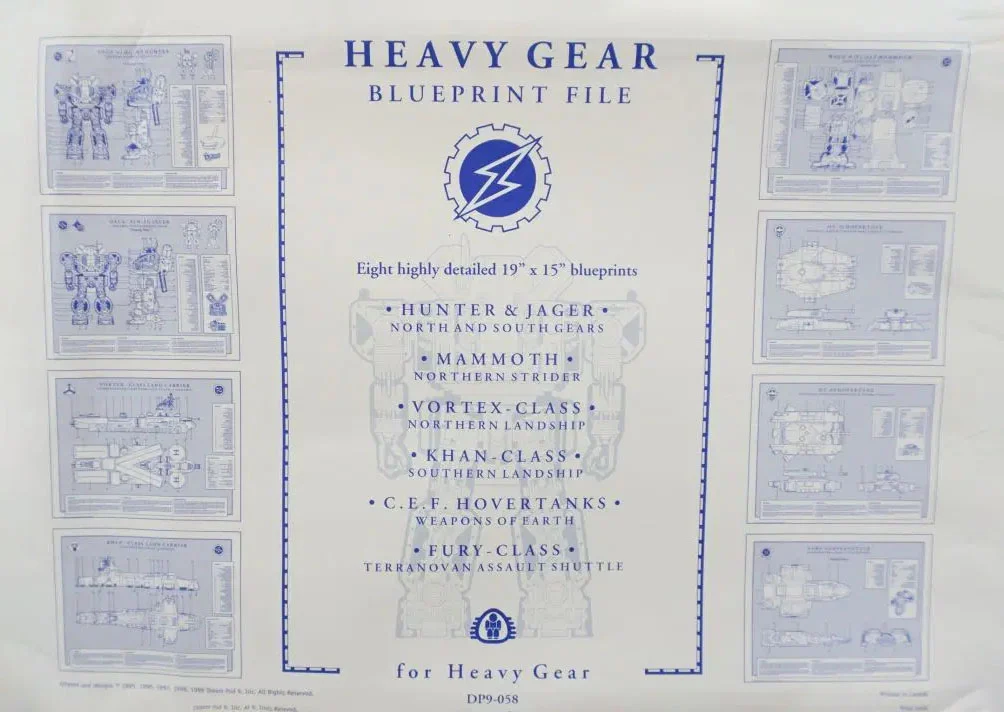
This distinctive product arrives thoughtfully packaged in a modest 8.5" x 11" white envelope, an unassuming facade for the treasures within. The cover artfully presents the title alongside a mini "table of contents," showcasing miniature renditions of the eight poster-sized blueprints that lie folded inside. Each blueprint measures an impressive 19" x 15", a scale that allows for intricate detail and a commanding presence. The collection features a curated selection of iconic Heavy Gear vehicles, including the ubiquitous Hunter gear, the formidable Jager gear, the colossal Mammoth strider, the sprawling Vortex and Khan landships, the advanced CEF hovertank, and the sleek Fury-class assault shuttle. More than mere technical drawings, each blueprint is enriched with detailed background text, precise specifications, and explanatory passages that delve into the design philosophy and operational nuances of the depicted craft.
The Heavy Gear Blueprint File serves a dual purpose, appealing both as an aesthetic display piece and a functional game prop. Its suitability for framing allows enthusiasts to adorn their personal spaces with striking representations of their favorite mecha and vehicles, fostering an atmosphere conducive to gaming or simply celebrating their passion for the universe. For Game Masters, these blueprints offer invaluable resources, transforming abstract concepts into concrete, visual aids that can enhance player immersion and serve as compelling handouts or tactical references during campaigns, particularly those involving the grand scale of landships. Despite its undeniable appeal to dedicated fans, the product prompts a recurring question regarding its broader utility, leading to its initial critical reception of a 5 for "Style" and a 4 for "Substance," a testament to its strong presentation but niche applicability. Priced at $9.95 with product code DP9-058, it represented an accessible entry point for fans seeking to deepen their engagement with the Heavy Gear universe.
Chronology
Dream Pod 9’s Genesis and Early Reputation
The narrative of Dream Pod 9 begins in the mid-1990s, a vibrant era for tabletop role-playing games where innovation was met with enthusiastic community engagement. Founded in Montreal, Quebec, DP9 quickly distinguished itself through a commitment to high-quality production values, particularly in its art and graphic design. This dedication was evident from the launch of its flagship game, Heavy Gear, in 1995, followed by Jovian Chronicles and Tribe 8. Each line offered distinct settings—Heavy Gear with its gritty, mecha-driven planetary conflicts on Terra Nova; Jovian Chronicles exploring space opera and political intrigue in the solar system; and Tribe 8 delving into a post-apocalyptic fantasy steeped in spiritualism and tribal struggles. What united these diverse universes was DP9’s meticulous approach to world-building, which extended beyond rulebooks to a rich tapestry of supplementary materials. The company’s reputation for "visual excellence" was not just a marketing slogan; it was a core pillar of its identity, drawing players into richly illustrated worlds populated by iconic designs that were both functional and aesthetically striking. This focus on strong visual branding laid the groundwork for products like the blueprint files, which aimed to physically manifest the detailed mechanics of their worlds.
The Era of Blueprint Files
The introduction of "blueprint files" into Dream Pod 9’s product lines marked an innovative step in the realm of RPG supplements. In the late 1990s and early 2000s, the RPG market, while diversifying, still heavily relied on traditional rulebooks and adventure modules. DP9, however, recognized the potential for supplementary products that catered to the aesthetic and immersive desires of its dedicated fanbase. The blueprint files emerged as a response to this, offering a tangible connection to the game world’s technology and designs. They tapped into a prevailing trend among gamers for deeper immersion and a desire for physical artifacts that could enhance their experience beyond the tabletop. At a time when digital assets were still nascent, high-quality physical props and visual aids held significant appeal. These files were not just random art prints; they were presented as in-universe technical documents, complete with specifications and annotations, designed to feel authentic. This move showcased DP9’s understanding of its audience’s "gearhead" tendencies, providing a product that appealed to both the strategic gamer and the collector who appreciated the intricate details of fictional machinery. The blueprint files were an embodiment of DP9’s commitment to delivering a holistic, immersive experience, offering a unique product that stood out in a competitive market.
The Original Review’s Publication
The review of the Heavy Gear Blueprint File originally saw publication on February 5th, 2002, on RPGNet. At the turn of the millennium, RPGNet stood as a preeminent online hub for the tabletop role-playing game community. It served as a critical platform for news, reviews, forums, and a vast database of RPG products, becoming an indispensable resource for players and publishers alike. Reviews published on RPGNet carried significant weight, influencing purchasing decisions and shaping public perception of new releases. The author of this particular review, a known contributor to RPGNet, provided an honest and direct assessment, reflecting the site’s editorial ethos of delivering practical insights for gamers. The review’s context within RPGNet is crucial; it was part of a larger conversation about supplementary materials and their value proposition in the burgeoning digital age. While the internet was growing, physical products still dominated, and detailed reviews like this helped consumers navigate the myriad options available. The article’s subsequent re-publication and contextualization by its author decades later highlight the enduring relevance of these early reviews, offering a snapshot of industry perspectives from a bygone era and providing valuable historical insight into product development and reception within the RPG community.
Evolution of Supplementary Materials
The landscape of RPG supplementary materials has undergone a profound transformation since the early 2000s, largely driven by technological advancements and shifting consumer habits. When the Heavy Gear Blueprint File was released, physical products like poster maps, card decks, and blueprint files were at the cutting edge of immersive aids. Today, while physical collector’s editions and deluxe boxed sets still thrive, the digital realm offers an unparalleled array of supplementary content. Game publishers now leverage virtual tabletop (VTT) platforms, providing digital tokens, interactive maps, 3D renders, and animated assets that bring game worlds to life on screens. High-resolution PDFs have largely replaced physical blueprint files for practical in-game reference, offering searchable text and zoom capabilities that physical prints cannot match. The rise of crowdfunding platforms has also enabled creators to produce highly specialized and often elaborate physical props, pushing the boundaries of what constitutes an "immersive supplement." However, this digital shift has also reignited appreciation for the tangible. Products like the blueprint file, once seen by some as niche, are now celebrated by collectors for their inherent physical quality and the nostalgic connection they provide. They represent a different kind of value—one rooted in tactile experience and the permanence of a physical artifact, standing in contrast to the ephemeral nature of digital files. This evolution underscores a broader market trend: while utility increasingly leans digital, the desire for beautiful, physical objects remains a strong motivator for dedicated fans.
Supporting Data
Deep Dive into Visual Excellence
Dream Pod 9’s commitment to visual excellence was not merely an aesthetic preference; it was a fundamental pillar of their game design philosophy, particularly evident in Heavy Gear. Their mecha designs were characterized by a pragmatic, industrial aesthetic that blended sleek futuristic lines with a believable sense of weight and functionality. Unlike some contemporary designs that leaned towards overly ornate or impossibly agile forms, DP9’s Gears felt like genuine war machines, grounded in plausible engineering principles. This distinctive style, often described as "real robot," differentiated them significantly in the market. The blueprint files exemplify this commitment to detail. Printed on substantial paper, the blueprints themselves are a masterclass in technical illustration. Crisp lines, precise cross-sections, and detailed component call-outs create an authentic "in-universe" feel. The choice of a subtle, muted color palette, mimicking traditional engineering schematics, further enhances this realism. Each blueprint doesn’t just show the external form of a Hunter Gear or a Mammoth Strider; it often reveals internal mechanisms, weapon hardpoints, and power conduits, offering a layered understanding of the craft. The accompanying background text and specifications are not generic flavor blurbs. Instead, they delve into the design rationale, operational history, unique features, and even the quirks of each vehicle, effectively turning each blueprint into a mini-lore sheet. This depth of detail transforms a simple poster into an educational artifact for any fan, allowing them to appreciate the intricacies of the Heavy Gear universe on a completely new level and showcasing DP9’s dedication to meticulous world-building through visual storytelling.
The Featured Designs
The selection of vehicles for the Heavy Gear Blueprint File was a deliberate curatorial choice, featuring a cross-section of iconic and strategically significant designs that collectively define the setting. Each blueprint offers a window into a specific facet of Terra Nova’s technological and military landscape:
- Hunter Gear: As the quintessential main battle Gear of the Northern Guard, the Hunter is arguably the most recognizable symbol of Heavy Gear. Its blueprint provides a foundational understanding of Gear design, showcasing its balance of mobility, firepower, and armor. It’s the workhorse, the everyman’s mecha, and its detailed schematics highlight the rugged simplicity that makes it so enduring.
- Jager Gear: Representing a more specialized variant, the Jager often serves in reconnaissance or skirmishing roles. Its blueprint would emphasize lighter armor, enhanced sensor suites, or unique movement capabilities, illustrating the tactical diversity within Gear combat and showcasing how designs adapt to specific battlefield roles.
- Mammoth Strider: A behemoth of the battlefield, the Mammoth Strider epitomizes heavy assault and strategic deployment. Its blueprint would reveal the sheer scale and complexity of such a war machine, detailing its massive weapon systems, armored plating, and the intricate articulation required for a multi-legged walker of its size, underscoring the high stakes of large-scale engagements.
- Vortex Landship & Khan Landship: These mobile fortresses are crucial to the lore and gameplay of Heavy Gear, often serving as moving headquarters, supply depots, or even entire settlements. Their inclusion provides a narrative anchor, detailing internal layouts, defensive systems, and operational components. For a campaign centered around such a vessel, these blueprints become indispensable, offering players and GMs a tangible representation of their environment.
- CEF Hovertank: Representing the technologically advanced and often alien threat of the Colonial Expeditionary Force, the Hovertank offers a stark contrast to the indigenous Gear designs. Its blueprint would highlight advanced propulsion systems, unique energy weapons, and composite armor, visually reinforcing the technological disparity and distinct design philosophies between the factions.
- Fury-class Assault Shuttle: Expanding beyond ground combat, the Fury-class shuttle introduces the aerial and orbital dimensions of the Heavy Gear universe. Its blueprint would detail atmospheric and vacuum flight capabilities, troop deployment mechanisms, and defensive armaments, showcasing the multi-domain warfare that characterizes the setting and the broader scope of the conflict.
Together, these blueprints offer a comprehensive overview of the Heavy Gear universe’s most vital machines, each contributing to a richer, more tangible understanding of the game’s technological backbone.
Practical Applications and Ambience
While the original review questioned the product’s ultimate utility, its practical applications, particularly for dedicated fans and Game Masters, are significant, especially when viewed through the lens of immersion and aesthetic enhancement. As display pieces, the blueprints excel. Their poster size and detailed artwork make them ideal for framing, allowing fans to transform their passion into visible decor. Imagine a gaming room adorned with the schematics of a Hunter Gear, or an office space where a Mammoth Strider’s intricate design inspires creative thought. This isn’t just about decoration; it’s about curating an environment that reflects and reinforces one’s interests. For the "gearhead" or any fan deeply invested in the Heavy Gear universe, these framed blueprints become a personal statement, adding authenticity and atmosphere to their surroundings. They serve as a constant visual reminder of the world they explore, enhancing the overall ambience of a game night and solidifying a sense of connection to the lore.
Beyond mere aesthetics, the blueprints truly shine as game props and handouts. In a tabletop RPG, tangible elements can dramatically elevate player engagement. A Game Master can utilize these blueprints in numerous ways:
- Tactical Planning: If players are tasked with infiltrating or defending a landship, presenting them with a physical blueprint of its layout can turn a vague objective into a concrete challenge, allowing them to strategize based on tangible information.
- Lore Integration: Discovering a rolled-up blueprint in a forgotten archive or looting one from a fallen enemy can be a thrilling in-game event, providing vital intelligence about enemy assets or lost technologies.
- Immersion and Detail: Handing a player the detailed schematic of their chosen Gear, complete with specifications and background, can deepen their connection to their character’s machine, making combat and maintenance feel more personal and real.
- Puzzle Elements: A damaged blueprint, with missing sections or cryptic annotations, could form the basis of a puzzle, requiring players to interpret fragmented information to achieve an objective.
These uses move beyond simple display, integrating the blueprints directly into the narrative and mechanics of the game. They transform abstract concepts into physical objects that players can interact with, fostering a deeper sense of immersion and making the campaign’s world feel more lived-in and real. For a game as mechanically rich as Heavy Gear, having such detailed visual aids can bridge the gap between imagination and reality, offering an unparalleled level of engagement for both players and GMs.
Official Responses
Dream Pod 9’s Design Philosophy
While the original review does not include direct official statements from Dream Pod 9 regarding the Heavy Gear Blueprint File, the product itself is a clear manifestation of the publisher’s overarching design philosophy. From its inception, Dream Pod 9 distinguished itself through a profound commitment to detailed world-building and unparalleled visual artistry. Their games were not just rule sets; they were fully realized universes, brought to life through intricate lore, engaging narratives, and, crucially, exceptional artwork. This philosophy extended beyond the core rulebooks to every supplementary product they released. DP9 understood that for players to truly invest in a fictional world, they needed to believe in its tangibility. The blueprint files perfectly encapsulate this approach: they are not just generic posters but rather in-universe documents, meticulously designed to feel authentic and to provide a deeper understanding of the technological backbone of Terra Nova.
This commitment to immersion through detail was a deliberate strategy by DP9 to foster a strong connection between players and their game worlds. By providing highly detailed schematics, background lore, and specifications, they empowered players to visualize and understand the mechanics of their chosen mecha and vehicles with unprecedented clarity. This wasn’t about maximizing sales through broad appeal, but about catering to a dedicated fanbase that appreciated the nuances of engineering and design within their sci-fi settings. DP9 consistently aimed to provide a comprehensive experience, offering products that supported various aspects of play—from tactical combat to deep narrative exploration. The blueprint files, therefore, were not an anomaly but a logical extension of a design philosophy that prioritized depth, authenticity, and visual storytelling, ensuring that every product, however niche, contributed to the richness and credibility of the Heavy Gear universe.
The Market Context and Niche Appeal
Dream Pod 9’s decision to produce supplementary materials like the Heavy Gear Blueprint File also speaks to their astute understanding of their market and their willingness to cater to niche interests. In the competitive landscape of the early 2000s RPG industry, publishers often faced pressure to produce products with mass appeal. DP9, however, recognized the strength of its core fanbase—a passionate community often referred to as "gearheads"—who possessed a deep appreciation for the mechanical intricacies and visual aesthetics of their games. The blueprint files were explicitly designed for this segment of the audience. They weren’t intended to be essential game mechanics; rather, they were collector’s items, display pieces, and immersive props that enhanced the overall experience for those already invested in the Heavy Gear universe.
This strategic targeting allowed DP9 to differentiate itself. While other companies might focus solely on adventure modules or character expansions, DP9 offered a more diverse range of products that appealed to various facets of fan engagement, from tactical gameplay to lore immersion and aesthetic appreciation. By providing products like the blueprint files, DP9 cultivated a sense of exclusivity and catered to the desire for tangible artifacts that solidified a fan’s connection to the brand. This approach not only fostered strong brand loyalty but also reinforced DP9’s identity as a publisher that deeply understood and valued its community’s specific passions. The "niche appeal" of the blueprint files was not a drawback but a deliberate strength, allowing DP9 to serve its dedicated audience with products that resonated deeply with their specific interests, further cementing their reputation for innovation and quality within the tabletop gaming industry.
Implications
Legacy and Enduring Appeal
The Heavy Gear Blueprint File, alongside Dream Pod 9’s broader range of visually-driven supplements, has left an indelible legacy within the tabletop gaming community, particularly for fans of the Heavy Gear universe. These products contributed significantly to the brand’s identity as a leader in detailed world-building and exceptional artwork. The precise, functional aesthetic of the Gears, brought to life through these blueprints, fostered an unparalleled sense of realism and immersion that continues to resonate with players decades later. For long-time fans, owning these blueprints is more than just possessing a game accessory; it’s holding a piece of the universe they cherish. The emotional connection cultivated by such products is profound, as exemplified by the reviewer’s anecdote about the Heavy Gear keychain. These physical artifacts become touchstones, unlocking "core memories" and reinforcing a deep, personal bond with the game. This enduring appeal speaks to the power of tangible media in an increasingly digital world. The blueprints offered a concrete, physical manifestation of the game’s intricate mechanics, allowing fans to connect with the lore and design philosophy of Heavy Gear on a more intimate level than a rulebook or digital image ever could. They helped solidify Heavy Gear‘s status not just as a game, but as a rich, believable universe that players could truly inhabit.
The Collector’s Perspective
From a collector’s standpoint, the Heavy Gear Blueprint File holds a unique place. While not necessarily a high-value item in the speculative market, its rarity and historical significance for dedicated fans make it a prized possession. Products like these, often produced in limited runs before the widespread adoption of print-on-demand, become increasingly difficult to acquire over time. For collectors, the joy lies not just in the potential monetary value, but in the satisfaction of owning a piece of gaming history. It represents a specific era of RPG publishing and a particular innovative approach by Dream Pod 9. These blueprints are artifacts that tell a story about the evolution of supplementary materials, the artistic direction of a beloved franchise, and the passionate community that embraced them. The physical act of unfolding a large-format blueprint, examining its intricate details, and appreciating the quality of its production evokes a different kind of pleasure than simply viewing a digital file. It’s a tactile experience that connects the collector directly to the craft and care that went into its creation. For those who curate a collection of Heavy Gear memorabilia, the blueprint file is an essential component, completing a tangible representation of their dedication to the franchise and serving as a testament to DP9’s unique contribution to the world of tabletop gaming.
Influence on Modern RPG Supplements
The innovative approach of Dream Pod 9 with its blueprint files, while niche, arguably foreshadowed and influenced aspects of modern RPG supplementary product design. In an era increasingly dominated by digital assets and virtual tabletops, there’s a growing appreciation for high-quality physical props and immersive components. Deluxe editions of RPGs often include poster maps, art prints, and even physical "in-world" documents, directly echoing the spirit of DP9’s blueprint files. Publishers recognize that while digital convenience is paramount for many, there’s a significant segment of the market that craves tangible, collector-grade items that enhance the physical gaming space. The blueprint files demonstrated that supplementary materials could extend beyond mere utility to become pieces of art or immersive artifacts that deepen a player’s connection to the game world. This philosophy can be seen in the rise of elaborate boxed sets, high-end art books, and even third-party creators producing bespoke props for popular RPGs. The enduring debate between digital convenience and physical tangibility highlights this shift: while digital offers accessibility and endless possibilities, physical items like the blueprints offer a unique, sensory experience that digital formats often struggle to replicate. DP9’s early venture into such specialized physical supplements showcased a forward-thinking understanding of how to cater to the immersive desires of a dedicated fanbase, laying groundwork for future trends in premium, tactile gaming accessories.
The "What Do You Do With It?" Question Revisited
The original reviewer’s central question, "What the heck do you do with it?", while valid in 2002, finds a more nuanced answer in today’s gaming landscape. In an era where "lifestyle gaming" and the celebration of fandom are prevalent, the utility of such a product extends far beyond mere functional application. The blueprints are, first and foremost, immersive artifacts. Their primary purpose is to deepen a player’s connection to the Heavy Gear universe by providing tangible, high-quality representations of its iconic machinery. For the dedicated fan, the answer to "what do you do with it?" is multifaceted:
- Aesthetic Display: They are designed to be framed and showcased, transforming a personal space into an extension of the game world. This isn’t just decoration; it’s an expression of identity and passion.
- Ambience Creation: In a game room, they contribute significantly to the atmosphere, setting the mood for a campaign and making the fictional world feel more real and present.
- Emotional Connection: For the "gearhead," they offer a tactile link to the machines they love, fostering a sense of ownership and appreciation for the detailed design.
- Niche Utility as Props: For Game Masters, their use as physical handouts or tactical aids remains invaluable for specific, high-stakes scenarios, providing a level of immersion that digital images cannot fully replicate.
The product’s true value lies not in universal, practical utility, but in its ability to enhance immersion, foster personal connection, and serve as a testament to the intricate world-building of Dream Pod 9. It caters to a specific desire for physical embodiment of a beloved fictional universe, proving that sometimes, the most valuable "use" for a product is simply to exist as a beautiful, tangible piece of a world you adore.
Conclusion
The Heavy Gear Blueprint File by Dream Pod 9 stands as a compelling testament to the publisher’s innovative spirit and unwavering commitment to visual excellence. Released in an era when supplementary materials were still largely functional, these blueprints carved out a unique niche, appealing directly to the "gearhead" segment of their fanbase. They are more than just technical drawings; they are portals to the meticulously crafted world of Terra Nova, offering a tangible connection to its iconic machines and deepening the immersive experience for players. While the initial review pondered their practical utility, their enduring appeal as display pieces, collector’s items, and potent game props highlights their true value. In a world increasingly dominated by digital interfaces, these physical blueprints represent a cherished link to the tactile pleasure of tabletop gaming, embodying Dream Pod 9’s legacy of bringing richly detailed science fiction universes to life. They remind us that sometimes, the most profound way to engage with a fictional world is to hold a piece of it in your hands.



Leave a Comment