Unveiling the Universal Soul: ‘The Treasury of Folklore’ Compendium Explores Humanity’s Shared Myths
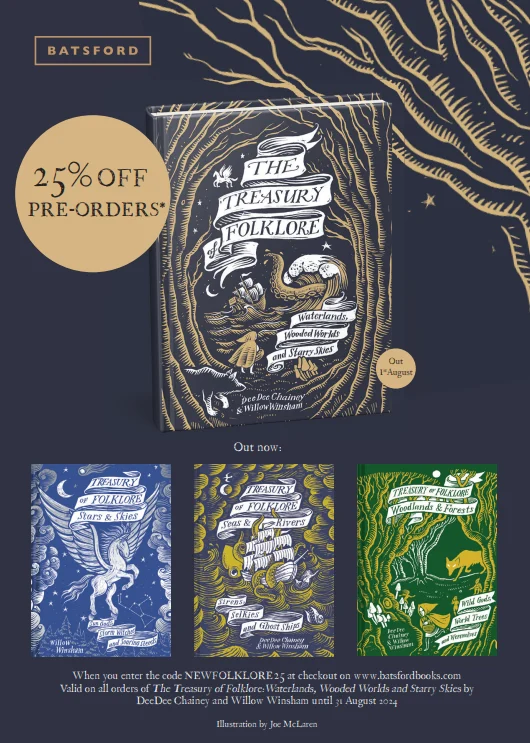
London, UK – July 25, 2024 – A decade-long journey into the heart of human storytelling culminates this August with the release of The Treasury of Folklore: Waterlands, Wooded Worlds and Starry Skies. This monumental compendium, published by Batsford Books, brings together the most cherished tales and insights from the acclaimed Treasury of Folklore series, fulfilling the authors’ original vision of a single, comprehensive volume exploring humanity’s intrinsic connection to the landscapes it inhabits.
Authored by renowned folklorists Dee Dee Chainey and Willow Winsham, with captivating illustrations by Joe McLaren, this "hefty tome" promises to be more than just a collection of stories. It is a profound exploration of the universal fears, dreams, and customs that bind diverse cultures across the globe, demonstrating that beneath the surface of varying traditions, humanity shares a remarkably consistent mythological DNA. Available for pre-order now and set for release on August 1, 2024, the book is poised to become an essential addition for enthusiasts of myth, cultural history, and the human condition.
The Genesis of a Grand Vision: From Concept to Compendium
The Treasury of Folklore series began nearly a decade ago, born from an ambitious concept: to create a singular volume that would traverse the myriad physical landscapes where humans reside worldwide, uncovering the folklore deeply embedded within them. The sheer volume and richness of the material quickly proved this initial vision too expansive for a single book, leading to the creation of three distinct, highly successful volumes: Seas and Rivers, Trees and Woodlands, and Stars and Skies.
The authors, deeply inspired by the vibrant global community fostered by the #FolkloreThursday hashtag, embarked on this literary quest with a clear objective: to craft something both meaningful and enduring, a testament to the unifying universality of folklore. Their journey led them to a profound realization. While the specific details of customs, beliefs, and tales varied from one locale to another, the underlying human experiences—primal fears of the unknown, aspirations for bounty, and awe at the cosmos—remained strikingly consistent. As the authors themselves reflect, "We discovered that we, as humans, all share primal fears and dreams, no matter where we live, how we dress, or what we choose to name the monsters of our myths and legends."
The popularity and heartwarming reception of the initial three books underscored the widespread hunger for these shared narratives. This success paved the way for a return to the original dream. When the opportunity arose to compile a compendium, Chainey and Winsham immediately recognized it as a chance to realize their foundational ambition. The process involved a meticulous re-evaluation of existing content, sifting through familiar words with fresh eyes to curate a selection that would seamlessly weave together the diverse threads of folklore into a cohesive, singular narrative that spans shared landscapes across time and place.
The result is a beautifully bound volume, lauded by the authors for its tactile quality, generous size, evocative cover art, and the luxurious feel of its cream paper. While it is important to note that the compendium does not introduce new material, drawing directly from the existing texts of the original series, its purpose is to consolidate and present this rich tapestry of human imagination in its most comprehensive form. Divided into three distinct sections mirroring the original books, the Treasury continues to feature the wonderful original illustrations of Joe McLaren, which bring an ethereal visual dimension to the ancient tales.
Echoes of Humanity: Folklore as Supporting Data
The true power of The Treasury of Folklore lies in its ability to illuminate the profound commonalities beneath superficial cultural differences. The selected extracts offer compelling evidence of how universal human experiences – encountering the unknown, navigating nature, and contemplating existence – manifest in distinct yet resonant narratives across continents.

Water Horses: Perilous Guardians of the Depths
Across the world’s waterways, from tranquil lakes to surging rivers, lurk magnificent yet malevolent creatures: water horses. These mythical steeds embody the human dread of the unseen dangers hidden beneath the surface, often luring the unwary to a watery demise.
-
The Scottish Kelpie: Perhaps the most famous, the Kelpie is a shape-shifting water spirit found in rivers, distinct from the each-uisge of lochs. It entices travelers onto its back before plunging them to their deaths. Scottish folklore, however, also offers hope for control, albeit fleeting, through a cross-marked bridle, and even a method for its destruction with red-hot iron. The enduring presence of the Kelpie in the Scottish imagination is dramatically visible in the colossal 30-meter-tall sculptures near Falkirk, a modern testament to an ancient legend. Its influence extends into contemporary literature, appearing in works by Lari Don and J.K. Rowling’s Fantastic Beasts and Where to Find Them, solidifying its place in global popular culture, despite its curious absence in English folklore south of the border.
-
The Welsh Ceffyl Dwr: In Wales, the Ceffyl Dwr was a prominent belief into the 19th century, exhibiting regional variations. In the north, it was a violent, shapeshifting spirit, while in the south, it consistently appeared as a small, enchanting horse, luring victims with its allure. Known for incredible speed, these horses could cover vast distances before vanishing, leaving riders to drown. Curiously, clergymen of any denomination were said to be immune to its malevolence, reaching their destinations unscathed while their companions often met a less fortunate fate.
-
The Scandinavian Bäckahäst: The "brook horse" of Scandinavia, often glimpsed in the fog, is described as a majestic, luminous being. Like its Celtic cousins, it beguiles riders, particularly children, before dragging them underwater. Yet, tales also speak of its vulnerability; it could be tricked or put to work. One popular story recounts how a group of boys playing on a frozen river were saved from a Bäckahäst by the accidental mispronunciation of "Jesus Christ," highlighting a common folkloric theme of supernatural beings recoiling from sacred names.
These water horses, despite their regional differences, collectively articulate a primal human caution against the deceptive beauty and hidden perils of nature, reflecting universal anxieties about the natural world’s unpredictable power.
Lords of the Wild: Nature’s Dual Sovereigns
Venturing into the verdant depths of forests and jungles reveals another category of powerful entities: the Lords of the Wild. These figures, whether malevolent or benevolent, embody humanity’s complex relationship with the untamed wilderness, serving as protectors, tricksters, or formidable adversaries.
-
The Finnish Tapio: Known also as Metsähine or Hiisi, Tapio is the venerable king of the Finnish forest realm. He is depicted as tall and thin, cloaked in ermine fur or moss, with a head topped by a hat and a face emerging from bushy eyebrows of moss and lichen, often with a great beard. His back, like a gnarled tree, signifies his profound connection to the woods. As the personification and protector of the forest, hunters traditionally sought his blessing for a successful hunt, pledging respect for the land and its creatures. Tapio, alongside his family—his wife Mielikki (or Kuurikki when displeased), son Nyrikki, and daughter Tulikki—governed all forest creatures, demonstrating a holistic, spiritual understanding of the ecosystem.

-
The Slavic Leshy: The leshy (or leshii, lyeshy) is a pivotal Slavic tutelary spirit, a protector of trees and animals, particularly wolves and bears, and famously hibernates in winter. Known by many names, all associating him with the forest, he is sometimes likened to Greek satyrs, sporting horns, claws, and a bushy, often forest-green beard, with cloven feet. A master shapeshifter, the leshy can alter his size from tree-tall to grass-short and assume the form of any forest inhabitant or plant. In human guise, he is identifiable by the absence of eyelashes or brows, shoes worn on the wrong feet, or clothing wrapped in a peculiar fashion. His wild hair and single eye are also common markers.
The leshy’s temperament is as variable as his form. His bellowing can whip up great winds, scattering all creatures in terror. He warns intruders with shrieking laughter, clapping, or howling; those who ignore these warnings are often led astray, confused, and lost to the wilds. Leshies are notorious tricksters, mimicking voices to lure victims, and even tickling them to death. They can inflict illness, abduct women for marriage, and snatch children. Farmers in regions like Olonetsky District in Russia would annually sacrifice a cow to appease them and protect their cattle. Offerings of bread and tobacco, or a simple prayer, were believed to safeguard against their wrath.
Leshies live alone or with their wives (lesovikha) and children, sometimes in forest huts. They are not above inter-species conflict, known to wield clubs and rip up trees during battles. Some tales even depict them frequenting taverns, gambling with squirrels, and playing cards (though notably, never with clubs, which resemble the Christian cross). Protection against a leshy mirrors remedies for other fae folk: turning clothes inside out or wearing shoes on the wrong feet, which is said to provoke laughter and return the lost to the correct path. Swearing at them or making the sign of the cross are other methods of banishment. For those daring enough to summon a leshy, the ritual involves cutting young birch trees, arranging them in a circle, and, free of Christian symbols, calling out to the "grandfather of the forest."
These varied portrayals of forest deities and spirits underscore humanity’s ancient reverence for, and simultaneous apprehension of, the wilderness, a theme that transcends cultural boundaries.
The Hare in the Moon: A Celestial Tapestry of Sacrifice and Fate
Perhaps one of the most widespread and evocative pieces of folklore is the image of a rabbit or hare living on the moon, a motif found across numerous cultures. The Moon’s Sea of Tranquillity, Fertility, and Nectar are often interpreted as the creature’s head and ears, a testament to humanity’s innate desire to find meaning and stories in celestial phenomena.
-
Buddhist Sasa-Jātaka: In this tale, a hare, along with its friends (an otter, jackal, and monkey), practices almsgiving. When the deity Sakka (a protector of Buddhism), disguised as an old man, tests their generosity, the otter, jackal, and monkey readily offer food. The hare, having only grass, nobly offers itself as sustenance by leaping into a fire. Sakka, moved by this ultimate act of faithfulness, saves the hare and sets its image upon the moon for all eternity, or draws it with the essence of a squeezed mountain.
-
Sri Lankan and Japanese Echoes: Similar narratives of a self-sacrificing hare resonate in Sri Lankan and Japanese folklore. In the Sri Lankan version, Buddha, lost and hungry, is offered the hare’s flesh. The hare throws itself into a fire conjured by Buddha, who then saves it and sends it to the moon. In Japan, where the rabbit is known as Tsuki no Usagi, the Man in the Moon descends as a beggar. The rabbit’s selfless act of offering itself to the fire, when it has nothing else, prompts the beggar to reveal his true form and take the rabbit to live with him on the moon. This poignant Japanese tale is a cherished narrative, often shared with children during the September Harvest Moon and Mid-Autumn Festival, linking the celestial body to themes of altruism and sacrifice.

-
The South African Counterpoint: A fascinatingly different narrative from South Africa presents the hare as a bringer of human mortality. Moon instructs Hare to deliver a message to humankind: just as she "dies" and returns each month, so too would humans. However, the flighty Hare misdelivers, stating that humans would simply die, without the promise of return. Enraged, Moon attacks Hare with a hatchet, only succeeding in splitting its lip. In retaliation, Hare lashes out, scarring Moon’s face – scars that, according to the tale, are still visible in the dark shapes on the moon today.
These lunar hare stories, whether celebrating selfless sacrifice or explaining existential truths like mortality, highlight humanity’s universal impulse to weave narratives around the cosmic ballet, imbuing the distant moon with relatable, human-like drama and meaning.
Official Voices and Enduring Implications
The authors express immense satisfaction with the culmination of their ambitious project. "To say we have been blown away by the end result is an understatement," they declare, "and we are utterly thrilled to be able to share this beautifully bound volume with you." Their gratitude extends to every reader who has supported the series, acknowledging the "surprising and heartwarming" popularity of their work.
While reiterating that The Treasury of Folklore: Waterlands, Wooded Worlds and Starry Skies contains no new textual material, the authors emphasize its intended role as a "beautiful addition to any book case or coffee table, a conversation starter, a way to connect." This compendium is not merely a re-packaging; it’s a curated experience designed to showcase the interconnectedness of human belief systems in a singular, aesthetically pleasing format. The inclusion of Joe McLaren’s exquisite original illustrations throughout further enhances its appeal, transforming the book into a visual as well as literary treasure.
The release of this compendium carries significant implications for both folklore studies and the broader cultural landscape. It reinforces the critical role of folklore in understanding human psychology, societal structures, and our enduring relationship with the natural world. By presenting these diverse myths side-by-side, the book serves as a powerful reminder that despite geographical distances and cultural divergences, humanity’s core concerns—survival, wonder, fear, and hope—remain remarkably consistent.
In an increasingly fragmented world, The Treasury of Folklore offers a unique pathway to connection. It encourages readers to look beyond superficial differences and recognize the shared threads of imagination and experience that weave through our collective human story. It’s an invitation to explore the primal landscapes of our ancestors’ minds, to find resonance in their fears and dreams, and to appreciate the enduring power of storytelling itself.
For those eager to embark on this grand journey, The Treasury of Folklore: Waterlands, Wooded Worlds and Starry Skies is available for pre-order now and will be released on August 1, 2024. As a special offer, readers can receive 25% off when ordering directly from Batsford Books using the code NEWFOLKLORE25, making this comprehensive exploration of human myth more accessible than ever. It is more than just a book; it is a testament to the universal soul of humanity, etched in the timeless tales of water, wood, and sky.