The Resurgence of the Boutique Indie: Trash Goblin’s Strategic Crowdfunding Success and the Evolution of Spilt Milk Studios
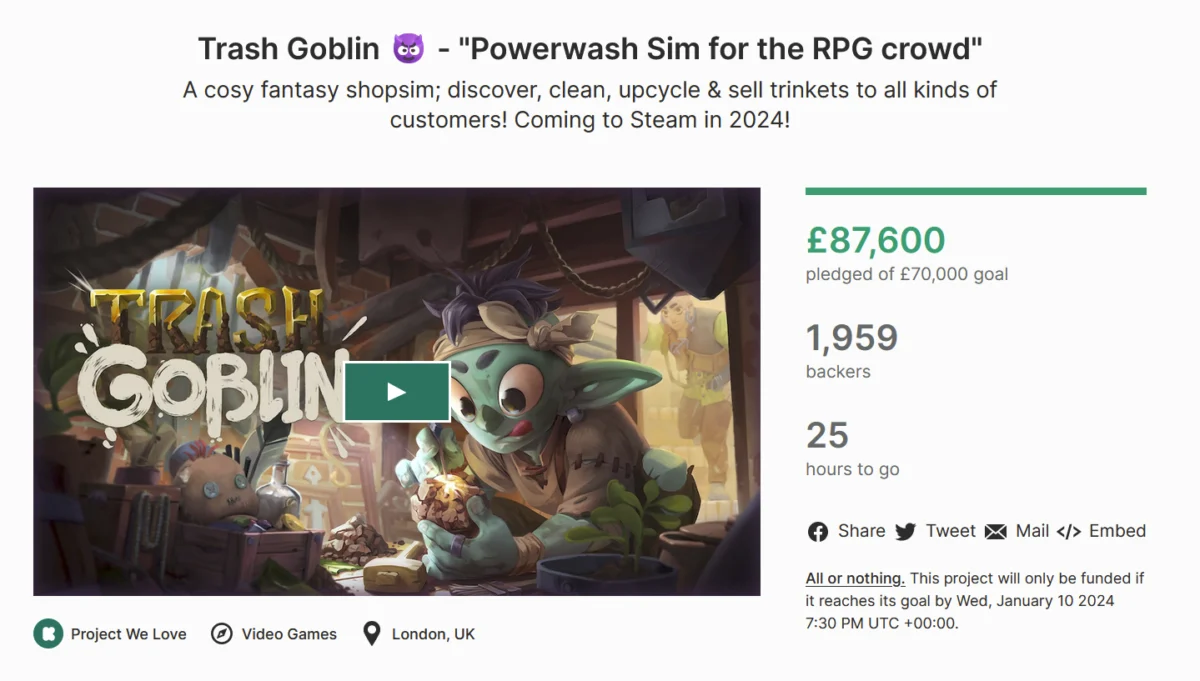
LONDON — In an era where the independent gaming market is often characterized by a "discoverability crisis," Spilt Milk Studios has defied the odds with its latest project, Trash Goblin. As of January 9, 2024, the studio’s Kickstarter campaign for the "cosy trinket-cleaning" simulator has reached a significant milestone, surpassing 124% of its initial funding goal with only 24 hours remaining in the campaign.
The success of Trash Goblin represents more than just a financial victory for a London-based indie developer; it signals a strategic pivot for the studio and highlights the evolving role of industry veterans in the self-publishing space. Central to this narrative is Nicholas Lovell, the founder of Gamesbrief and a renowned game business strategist, who has recently transitioned from a non-executive role to an executive position within Spilt Milk Studios to spearhead this new chapter.
Main Facts: A "Powerwash Simulator" for the RPG Audience
Trash Goblin is billed as a wholesome, cozy shopkeeping and restoration simulator. The core gameplay loop involves discovering discarded trinkets, cleaning them with various tools, repairing broken components, and eventually upcycling them to sell to a cast of eccentric fantasy characters. The game has frequently been compared to Powerwash Simulator due to its satisfying, tactile cleaning mechanics, but it differentiates itself by embedding these tasks within a rich, character-driven RPG world.
The Kickstarter campaign was launched to bridge the gap between prototype and full production, allowing the studio to maintain its independence. With the funding currently sitting at over 124% of its target, the studio is now eyeing a "stretch goal" of £100,000 to further expand the game’s features and polish.
Beyond the financial metrics, the campaign has served as a primary driver for Steam wishlists—a critical currency in the modern PC gaming ecosystem. The studio has urged supporters to not only back the project financially but to engage with the Steam platform to ensure a successful commercial launch.
Chronology: From Concept to Crowdfunding Triumph
The journey of Trash Goblin began long before its Kickstarter debut. Spilt Milk Studios, founded by Andrew J. Smith, has spent over a decade navigating the volatile waters of indie development, with titles such as Lazarus and Tango Fiesta. However, the conception of Trash Goblin marked a shift toward the burgeoning "cozy game" genre, which saw a massive surge in popularity during and after the global pandemic.
The Development Phase
Throughout 2023, Spilt Milk focused on refining the "tactile satisfaction" of the game. They recognized that the appeal of restoration videos on social media—where rusted objects are polished to a mirror finish—could be translated into a compelling digital experience.
The Strategic Pivot
In late 2023, Nicholas Lovell stepped up his involvement with the studio. Lovell, known for his "The Curve" philosophy—which emphasizes finding a niche audience and providing them with varying levels of value—saw Trash Goblin as the perfect vehicle for a community-led publishing model. Despite battling the lingering effects of Long Covid, which has restricted him to a part-time capacity, Lovell’s transition to an executive role was designed to professionalize the studio’s business operations and marketing outreach.
The Kickstarter Launch
The campaign launched in late 2023 with a modest but essential goal. Unlike many "mega-projects" on Kickstarter, Spilt Milk aimed for a figure that would genuinely support development without over-promising. The project hit its 100% funding mark shortly after the New Year in 2024, providing the team with a significant morale boost during the traditionally slow January period.
The Final Push
As of January 9, 2024, the campaign entered its "final 24-hour" countdown. This period is often the most lucrative for crowdfunding projects, as "remind me" emails are triggered for thousands of potential backers who watched the project during its mid-campaign slump.
Supporting Data: The Economics of "Cozy" Restoration
The success of Trash Goblin is backed by broader market trends within the gaming industry. The "Cozy Games" tag on Steam has seen an exponential increase in traffic over the last three years. According to industry analysts, games that prioritize relaxation, creativity, and "low-stakes" gameplay have become a preferred alternative to the high-stress environments of competitive multiplayer titles.
Crowdfunding Metrics
- Funding Percentage: 124% (as of Jan 9, 2024).
- Key Milestone: Surpassing the initial goal in early January.
- Target Stretch Goal: £100,000 (The "Magic Number").
- Backer Sentiment: High engagement in the comments section, with a focus on tool variety and the "goblin" lore.
The "Steam Wishlist" Factor
In modern game publishing, 10,000 to 50,000 wishlists are often considered the "minimum viable" threshold for a successful indie launch on Steam. The Kickstarter campaign for Trash Goblin has acted as a secondary marketing funnel, successfully converting social media interest into tangible Steam footprints, which informs the platform’s algorithm to promote the game upon release.

Official Responses: A Personal and Professional Milestone
Nicholas Lovell’s public statement regarding the campaign highlights both the professional success and the personal challenges of modern game development.
"I’m so excited that the Kickstarter I’m part of has funded," Lovell stated. Commenting on his new role, he noted, "I’ve recently stepped up from a non-executive role at Spilt Milk to an executive one. I’m still part-time (I hate you, long Covid), but I’m much more involved."
Lovell’s involvement is a significant endorsement of the project’s business viability. As the author of How to Publish a Game and The Curve, his move from advisor to executive suggests a deep confidence in the "Trash Goblin" IP. He describes the game as "Powerwash Simulator for the RPG crowd," a pithy elevator pitch that has clearly resonated with the gaming public.
Andrew J. Smith, the founder of Spilt Milk Studios, has echoed this sentiment in community updates, emphasizing that the funds will be used to ensure the game remains "weird, wonderful, and uncompromisingly indie."
Implications: The Future of Self-Publishing and Indie Sustainability
The success of the Trash Goblin Kickstarter carries several implications for the wider indie development community.
1. The Viability of the "Boutique" Executive
Lovell’s role suggests a new model for indie studios: bringing in high-level strategic "executives" on a part-time or fractional basis. This allows small teams to benefit from decades of industry experience in marketing and monetization without the overhead of a full-time C-suite salary. It also provides a pathway for talented professionals dealing with chronic illnesses, such as Long Covid, to remain impactful in the industry.
2. Crowdfunding as Validation, Not Just Capital
For Spilt Milk, the 124% funding is a "proof of concept." In an era where publishers are becoming increasingly risk-averse, having a pre-existing community of thousands of paying customers is a powerful tool. If the studio chooses to seek further investment or a publishing partner for console ports, they now possess the data to prove market demand.
3. The "Wholesome" Trend is Here to Stay
The enthusiasm for a game about cleaning trash in a fantasy setting confirms that the "Wholesome Games" movement is not a fleeting trend. There is a sustainable market for games that offer "digital chores" as a form of mindfulness. By combining this with RPG elements—character progression and world-building—Trash Goblin is positioning itself to capture both the casual "sim" player and the more dedicated RPG enthusiast.
4. The Importance of the Final 24 Hours
As the clock ticks down toward the £100,000 mark, the next 24 hours will determine the scope of Trash Goblin’s initial launch. Reaching the "magic £100k" would allow for additional "stretch goal" content, potentially including more complex tools, more varied trinkets, or expanded character interactions.
Conclusion
As the Trash Goblin Kickstarter concludes, the focus will shift from fundraising to production. For Nicholas Lovell and the team at Spilt Milk Studios, the challenge now lies in delivering on the high expectations of their 124% funded community. In a year that has already seen significant volatility in the gaming sector, the story of a small team successfully restoration-modeling their way to a six-figure funding goal is a rare and welcome piece of positive news for the indie scene.
For those looking to support the project, the window is closing, but the momentum behind Trash Goblin suggests that this is only the beginning of its journey from a pile of digital "trash" to a polished indie treasure.