The Treasury of Folklore Unveils a Unified Compendium: A Decade-Long Journey into Humanity’s Shared Myths
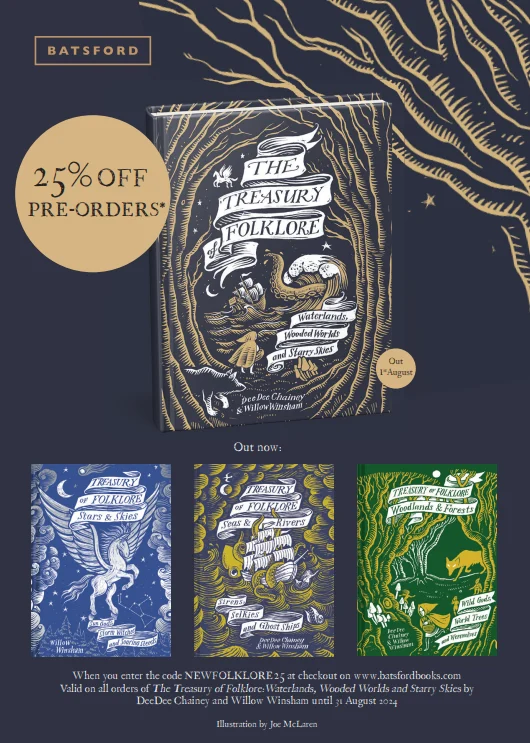
LONDON, UK – Nearly a decade after embarking on a quest to chart the rich tapestry of global folklore, authors Dee Dee Chainey and Willow Winsham are set to release a landmark compendium, "The Treasury of Folklore: Waterlands, Wooded Worlds and Starry Skies." This ambitious volume, available for pre-order now and launching on August 1st, 2024, finally consolidates the beloved content from their three original books into a single, beautifully bound edition, fulfilling their initial vision of a universal exploration of human belief.
The new compendium, published by Batsford Books, is more than just a collection; it represents a culmination of years of meticulous research and a profound understanding of how humans across diverse cultures grapple with primal fears, dreams, and the mysteries of the natural world. From the treacherous depths of ancient waterways to the silent majesty of star-strewn skies, the book highlights the enduring power of storytelling to connect us all.
A Vision Realized: From Single Idea to Comprehensive Series
The genesis of "The Treasury of Folklore" series began with a grand, singular ambition: to create one definitive book that would traverse the myriad physical landscapes inhabited by humans worldwide, exploring the folklore intrinsically linked to each environment. However, the sheer volume and richness of the material unearthed by Chainey and Winsham quickly proved that such a vast narrative could not be confined to a single volume.
Inspired by the vibrant global community fostered by the #FolkloreThursday hashtag – a phenomenon that underscored the universal appetite for traditional tales – the authors felt compelled to create something both meaningful and lasting. Their aim was to reflect the unifying universality of folklore, demonstrating how shared human experiences manifest in diverse cultural narratives. This led to the creation of the highly popular three-book series: Seas and Rivers, Trees and Woodlands, and Stars and Skies. The success of these individual volumes, Chainey and Winsham admit, was both surprising and profoundly heartwarming, cementing their resolve to continue their exploration of humanity’s narrative heritage.
The idea for a compendium, first suggested by their publisher, resonated deeply with the authors. It offered the perfect opportunity to revisit their original vision, bringing together the vast array of stories as initially conceived: within one comprehensive volume. This undertaking required significant behind-the-scenes work, involving a fresh re-evaluation of material they already knew intimately. The meticulous process of selecting what to include and what to judiciously omit was guided by the desire to create a cohesive narrative that gracefully spans shared landscapes across time and place. The end result, a "hefty tome" featuring a thoughtfully designed cover and exquisite cream paper, has reportedly "blown away" the authors, who are thrilled to share this definitive edition with readers.
The Compendium: A Curated Journey Through Myth
While "The Treasury of Folklore: Waterlands, Wooded Worlds and Starry Skies" does not contain new material, it serves as an unparalleled curated collection, drawing directly from the existing three books. It is designed not only as a beautiful addition to any bookshelf or coffee table but also as a catalyst for conversation and a means of connection, inviting readers to delve into the shared heritage of human imagination.
The compendium is thoughtfully structured into three distinct sections, each echoing the themes of the original books and magnificently brought to life by the original, wonderfully intricate illustrations of Joe McLaren. These artworks are integral to the book’s immersive quality, providing visual anchors for the fantastic creatures and mystical landscapes described.
The enduring appeal of these stories, as the authors highlight, lies in their ability to reveal fundamental truths about the human condition. Despite superficial differences in dress, language, or the names we give to our mythical beasts, we are all inherently the same. We share primal fears, whether it’s dreading the unknown around a campfire in a dark forest, or gazing in awe at the ancient stars, contemplating the brevity of our lives against the backdrop of eternity. Similarly, we all harbor dreams of adventure and long for the treasures the wide world promises. Folklore, in its essence, becomes a mirror reflecting these universal experiences.

Folklore Spotlights: Glimpses from the Treasury
To offer a taste of the rich narratives contained within the new compendium, here are some illustrative extracts, showcasing the depth and breadth of its folkloric explorations.
Water Horses: Majestic and Malevolent Creatures from the Depths
The compendium plunges into the perilous lore of water horses, creatures that lurk beneath the world’s lakes and waterways, blurring the lines between cautionary tale and terrifying reality. The narrative often begins with a weary traveller, lured by the promise of an easy journey, only to become the unsuspecting victim of one of folklore’s less benevolent entities.
Perhaps the most famous of these is the Scottish kelpie, though the book meticulously distinguishes it from the each-uisge. While both are malevolent water horses, kelpies are typically found in rivers, whereas the each-uisge prefers the deeper, more expansive waters of lochs and lakes. These creatures, in their most fearsome guise, drag their unsuspecting riders to a watery grave. Yet, tales also speak of fleeting control; a bridle marked with a cross might temporarily tame a kelpie, making it do one’s bidding, but this control is illusory, vanishing as the creature returns to its aquatic domain, often taking the rider with it. Intriguingly, some legends even suggest a means of destruction: red-hot iron, a common bane for many folkloric entities.
The lasting grip of the kelpie on the Scottish imagination is dramatically visible in the colossal 30-meter (98-foot) sculptures near Falkirk, which have stood as monumental testaments to the legend since 2013. Its presence in modern literature, from children’s authors like Lari Don to J.K. Rowling’s Fantastic Beasts and Where to Find Them, further attests to its enduring cultural resonance.
South of the Scottish border, however, English folklore surprisingly lacks its own distinct water horses, leaving its rivers and lakes decidedly less populated by such mythical steeds. This deficit is swiftly redressed in Wales, where the Ceffyl Dwr remained a staple of folkloric belief well into the 19th century. These Welsh water horses varied in appearance and intent; in the north, they were shapeshifting spirits prone to violence, while in the south, they consistently appeared as enchanting, small horses that lured people onto their backs. Known for their impossible speed, Ceffyl Dwr could cover vast distances in moments before vanishing, leaving their hapless riders to drown. A curious exception to their malevolence was their treatment of clergymen of any creed, who were said to be able to ride them unscathed, while their accompanying deacons or clerks were often abandoned or thrown into the water.
Scandinavian folklore introduces the bäckahäst, or ‘brook horse,’ often sighted in foggy conditions. Described as majestic and luminous, this creature beguiles riders before plunging back into the water, trapping its victims. Tales frequently feature children as riders, perhaps to heighten the sense of peril and tragedy. One popular story tells of boys playing on a frozen river, lured onto a beautiful horse. When the last child marvels at the sight, mispronouncing a phrase to include "Jesus Christ," the horse vanishes, leaving the children sore but saved, as the bäckahäst reportedly abhors the sacred name. Despite their terrifying reputation, many bäckahäst tales conclude with the riders surviving, and like the kelpie, they could sometimes be put to work if tricked.
Lords of the Wild: Shapeshifting Gods and Protectors of Nature
Leaving the watery depths behind, the compendium then ventures into the verdant heart of forests and jungles, the domain of powerful spirits and creatures known as the Lords of the Wild. These figures range from malevolent beings that wreak havoc and destruction to protective wild men who safeguard the creatures and trees within their realms. The book peels back the leafy shadows to reveal their true faces and varied roles across cultures.
The Forest God Tapio, Finnish: Tapio, also known as Metsähine or Hiisi, reigns as the Finnish king of the forest. Depicted as tall and thin, with a coat of ermine fur or moss and a cap on his head, he embodies the very essence of the forest. Like the Green Man figures of European folklore, he peers out from bushy eyebrows of moss and lichen, often sporting a great beard of straggling black hair. He is said to appear fully human from the front but possess the gnarled back of a tree, standing as tall as any ancient sentinel. Tapio is both the personification and the protector of the forest. Historically, hunters would seek his blessing before a chase, pledging respect for the land and its creatures, ensuring a plentiful haul or risking an empty-handed return. His Estonian counterpart shares similar attributes but, akin to the Norse god Odin, possesses only one eye.

Tapio, like many Finnish deities, has a family: his wife, Mielikki (or Kuurikki when malevolent); his son, Nyrikki, who guides hunters with trail marks; and his daughter, Tulikki, who directs prey towards them. This familial structure underscores a deep, relational understanding of nature in Finnish belief.
The Leshy, Slavic: The leshy (also leshii or lyeshy) is a pivotal tutelary spirit of Slavic woodlands, revered as a protector of trees and animals. In Ukraine, he is particularly associated with wolves, while others consider him a servant to the bear. Like bears, the leshy hibernates in winter. Known by many names, all emphasize his connection to the forest and his perceived subservience to either the woodsman or the Devil. Often likened to Greek satyrs, he is depicted as human above the waist but with horns, claws, and a bushy, often forest-green or moss-covered beard. A master shapeshifter, the leshy can alter his size and form at will, appearing taller than a tree or as small as a blade of grass, or even disguising himself as familiar humans, animals, or plants. When in human form, he can be identified by his lack of eyelashes or brows, shoes worn on the wrong feet, or garments wrapped in a manner opposite to local fashion. Some have only one eye, but all are covered in wild hair, often with the cloven feet reminiscent of fauns or even the Devil. Certain regional variations describe him with wings and a black furred tail, or dressed in white with swollen eyes.
The leshy‘s presence can be terrifying; his bellowing whips up great winds, sending forest creatures fleeing. Uninvited human encroachers who ignore his warning shrieks, claps, or howls are often lost by morning, confused and disoriented by the leshy‘s power to manipulate their surroundings. As a trickster figure, the leshy can mimic voices, luring victims to their demise through tickling, or creating sounds like creaking branches and rustling leaves. He can inflict illness, abduct women for marriage, or steal children who wander too deep into the woods or are cursed by their parents. Farmers in the Olonetsky District of Russia once sacrificed a cow annually to appease him and protect their herds from his wrath, which could include sucking milk from their cattle. Offerings of bread or tobacco, or a prayer before entering the forest, were believed to ensure safety.
Leshies are said to live alone or with their wives, the lesovikha, and children, sometimes in woodland huts. They are not above battling their own kind with clubs, ripping up trees in their conflicts. One leshy from Vologda District was even rumored to frequent local taverns, driving his wolf pack and guzzling vodka before returning to the night. They are notorious gamblers, often bartering with squirrels or playing cards, though they avoid decks with clubs, which resemble the Christian cross.
Methods to ensure safety against leshies, akin to fae folk worldwide, include turning one’s shirt inside out and wearing shoes on the wrong feet, a trick said to provoke laughter and return the lost individual to their rightful path. More specific rituals involve stripping naked and redressing all clothes backward. Swearing profusely is also said to make them leave, while making the sign of the cross offers a less theatrical banishment. To summon a leshy, one must enter the forest, cut young trees (birch is preferred), arrange them in a circle with tops touching, stand in the center devoid of Christian symbols, and call out to the "grandfather of the forest."
The Hare: A Celestial Resident of the Moon
Finally, the compendium turns its gaze skyward, exploring one of the most widespread and ancient motifs associated with the moon: the presence of a rabbit or hare. This motif is found in diverse cultures across the globe, with the Sea of Tranquility often identified as the rabbit’s head, and the seas of Fertility and Nectar forming its ears.
One prominent narrative comes from the Buddhist Sasa-jātaka. In this story, the hare, alongside his friends—an otter, a jackal, and a monkey—advocates for giving alms. On a forthcoming fast day, a deity named Sakka, ruler of the Trāyastriṃśa heaven and a protector of Buddhism, descends to Earth disguised as an old man to test their generosity. While his companions readily offer food they possess, the hare, having only grass, offers himself as a meal by leaping onto a fire. Sakka, moved by this faithfulness, saves the hare from the flames and places him on the moon for all to see. Some versions suggest Sakka extracted essence from a mountain to draw the hare’s image on the lunar surface. Similar self-sacrificing hare stories exist in other cultures, often with different animal companions.
A tale from Sri Lanka recounts Buddha, lost and hungry in a wood, being offered assistance by a hare. When Buddha states he cannot pay for the services, the hare immediately offers himself as food. As Buddha builds a fire, the hare throws himself into it, only for Buddha to use his powers to save the selfless creature and send him to the moon.

In Japan, the rabbit, known as Tsuki no Usagi (Moon Rabbit), features in a popular tale told to children during the Harvest Moon and Mid-Autumn Festival in September. Here, the Man in the Moon descends as a beggar. Other animals offer him food, but the rabbit, with only grass, sacrifices himself on a fire. The beggar then transforms into his true form and takes the selfless rabbit to live with him on the moon.
A different, more poignant narrative from South Africa attributes humankind’s mortality to the hare. The Moon sends the Hare to convey a message to humanity: just as the Moon "dies" and is reborn each month, so too would humankind. However, the flighty Hare misdelivers the message, telling people only that they would die. Enraged upon learning of the Hare’s error, the Moon attacks him with a hatchet, intending to split him in two, but only succeeds in splitting his lip. In retaliation, the Hare lashes out with his claws, scarring the Moon’s face, marks that are still visible as the dark shapes on the lunar surface today.
The Enduring Power of Shared Stories
The release of "The Treasury of Folklore: Waterlands, Wooded Worlds and Starry Skies" is more than just a book launch; it is a celebration of the enduring human spirit and our universal need to make sense of the world through story. Dee Dee Chainey and Willow Winsham have, over a decade, crafted a series that not only preserves ancient tales but also illuminates the profound connections between diverse cultures.
The compendium stands as a testament to the idea that beneath the surface of varied customs and beliefs, humanity shares a fundamental narrative—a collective consciousness shaped by the landscapes we inhabit and the celestial bodies that inspire our awe. It is a vital contribution to the preservation of cultural heritage and a powerful reminder that our shared fears, dreams, and wonders transcend geographical boundaries.
Readers eager to embark on this grand folkloric journey can pre-order "The Treasury of Folklore: Waterlands, Wooded Worlds and Starry Skies" now. The book will be officially released on August 1st, 2024. A special 25% discount is available when ordering directly from Batsford Books using the code NEWFOLKLORE25.
For further details and pre-order options, visit:
- Amazon UK
- Batsford Books (use code NEWFOLKLORE25 for discount)
The authors express their heartfelt gratitude to every reader who has supported the series, enabling this ambitious project to come to fruition. This "hefty tome" is poised to become a cherished volume, inspiring countless new conversations around the primal stories that bind us all.