Mesopotamia, circa 2000 BCE – In a profound testament to the timeless nature of human emotion, the world’s oldest known love poem, "The Love Song for Shu-Sin," emerged from the sands of ancient Mesopotamia. Composed roughly four millennia ago, this lyrical piece was not merely a declaration of affection but an integral part of sacred fertility rites, a powerful invocation aimed at securing prosperity for the Sumerian kingdom. Its discovery in the 19th century and subsequent translation in the 20th century dramatically reshaped our understanding of ancient literature, dethroning the biblical Song of Songs from its long-held position as the earliest extant love poem.
The rediscovery of "The Love Song for Shu-Sin" stands as a beacon of archaeological triumph, highlighting how patient scholarship and fortuitous finds can continually rewrite the annals of human history. Far from being a simple romantic verse, this poem offers a rare glimpse into the complex interplay of religious belief, royal power, and personal sentiment in one of the world’s earliest civilizations.
A Revelation from Ancient Mesopotamia
For centuries, the Song of Songs, also known as the Song of Solomon, from the Hebrew Bible, was widely considered to be the most ancient example of poetic romantic expression. Dated between the 6th and 3rd centuries BCE, its rich imagery and passionate verses resonated deeply across cultures and generations. However, the unearthing of cuneiform tablets from Mesopotamia irrevocably altered this perception. "The Love Song for Shu-Sin," dating back to approximately 2000 BCE, pushes the origins of recorded romantic poetry back by over a millennium, firmly establishing Mesopotamia as the birthplace of this literary tradition. Its existence underscores the sophistication of Sumerian society and its capacity for expressing profound human experiences in written form, long before many other civilizations flourished.
The Quest for Corroboration: Archaeology’s Unexpected Discoveries
The 19th century marked a fervent period of archaeological exploration in the region then known as Mesopotamia, driven largely by a prevailing desire to find tangible evidence supporting the narratives of the Old Testament. Expeditions, often funded by public interest eager for biblical corroboration, embarked on ambitious digs. Yet, the results often defied initial expectations, leading to discoveries that fundamentally challenged preconceived notions about the chronology and origins of Western civilization’s foundational texts.
Layard’s Expeditions and the Myth of Nineveh
One of the pivotal figures in this era was the archaeologist Austen Henry Layard. In 1845, Layard, assisted by Hormuzd Rassam, commenced excavations at Kalhu (modern Nimrud). Under immense pressure to unearth sites mentioned in the Bible, Layard initially, and mistakenly, concluded that the sprawling ruins he was uncovering belonged to the legendary city of Nineveh. His published account of these early excavations, Nineveh and its Remains (1849), became an instant bestseller. The book’s popularity, fueled by Nineveh’s prominent biblical fame, ignited further public and academic interest in Mesopotamian history, spurring additional expeditions to search for other biblical cities.
This early misidentification, while understandable given the context, underscores the powerful influence of the biblical narrative on 19th-century archaeology. The romanticized image of explorers unearthing lost biblical cities captivated the public imagination, ensuring continued funding for these ambitious, often perilous, ventures.
The Library of Ashurbanipal and a Paradigm Shift
However, the true significance of these Mesopotamian digs began to unfold with Layard’s subsequent, more accurate, excavation of the actual site of Nineveh between 1846 and 1847. Here, Layard made one of the most monumental discoveries in archaeological history: the Library of Ashurbanipal. This colossal repository, the "pet project" of the great Assyrian king Ashurbanipal (reigned 668-627 BCE), contained an astonishing collection of over 30,000 cuneiform tablets.
The sheer volume and diversity of these texts were staggering. It was the painstaking work of pioneering Assyriologists, most notably George Smith, in translating these cuneiform scripts that truly revolutionized scholarship. Smith’s translations revealed that many narratives previously thought to be original compositions of Hebrew scribes, such as the story of the Fall of Man, the Great Flood, and Noah’s Ark, were in fact pre-existing Mesopotamian tales. Texts like the Myth of Etana, the Eridu Genesis, and the Atrahasis provided undeniable evidence that these stories had deep roots in the Mesopotamian cultural landscape, adapted and reinterpreted by later Hebrew authors.
This revelation had a profound impact, not only on biblical scholarship but on the entire understanding of world history. It challenged the prevailing Eurocentric view that the Bible represented the absolute genesis of written history and narrative. Instead, it revealed a far older, richer tapestry of human thought and storytelling, demonstrating that ancient Mesopotamia was a vibrant cradle of civilization, influencing later cultures in ways previously unimagined. It was within this context of re-evaluating historical primacy that "The Love Song for Shu-Sin," once translated, found its true place, unequivocally displacing the Song of Songs as the world’s oldest love poem.
Deciphering the Past: The Unveiling of "The Love Song for Shu-Sin"
The journey of "The Love Song for Shu-Sin" from a forgotten fragment to a celebrated piece of world literature is a tale of serendipity and dedicated scholarship. Discovered amidst the ruins of Nineveh, the unassuming clay tablet containing the poem embarked on a long dormancy before its profound significance was recognized.
Samuel Noah Kramer’s Serendipitous Find
Following its excavation, the cuneiform tablet bearing "The Love Song for Shu-Sin" was transported to the Istanbul Museum in Turkey. There, it lay, untranslated and largely unnoticed, stored in a drawer amongst countless other artifacts, for decades. It was not until 1951 that its true nature was revealed, thanks to the meticulous work of the renowned Sumerologist Samuel Noah Kramer. Kramer, a scholar dedicated to deciphering the vast literary heritage of Sumer, was in the midst of choosing new texts to translate when fate intervened.
He vividly recounted this momentous discovery in his seminal work, History Begins at Sumer:
"The little tablet numbered 2461 was lying in one of the drawers, surrounded by a number of other pieces. When I first laid eyes on it, its most attractive feature was its state of preservation. I soon realized that I was reading a poem, divided into a number of stanzas, which celebrated beauty and love, a joyous bride and a king named Shu-Sin (who ruled over the land of Sumer close to four thousand years ago). As I read it again and yet again, there was no mistaking its content. What I held in my hand was one of the oldest love songs written down by the hand of man." (Kramer, p. 245)
Kramer’s description captures the thrill of intellectual discovery, the moment when an ancient artifact transcends its material form to speak across millennia. His careful translation brought to life the tender, passionate words of a long-lost poet, instantly adding a new dimension to our understanding of ancient human emotion.
A Voice from Four Millennia Ago
The translation of "The Love Song for Shu-Sin" was more than just an academic achievement; it was a powerful act of historical reclamation. It provided a direct, intimate voice from a civilization that had long been silent, offering an unparalleled insight into the emotional landscape of ancient Sumerians. The poem’s eloquent verses, brimming with adoration and longing, resonated with universal themes of love and desire, bridging the vast chasm of time. This particular tablet, designated as "2461," became a cornerstone in the study of Sumerian literature, illustrating the sophisticated poetic traditions that flourished in Mesopotamia during the Ur III period. It underscored that the capacity for expressing deep, personal affection through written verse is not a recent development but an ancient, enduring facet of human culture.
More Than Romance: The Sacred Context of the Poem
While "The Love Song for Shu-Sin" is undeniably a testament to romantic and erotic love, its original purpose extended far beyond mere sentiment. It was a crucial component of a sacred ritual, deeply intertwined with the prosperity and well-being of the Sumerian kingdom.
The Sacred Marriage Ritual: Ensuring Fertility and Prosperity
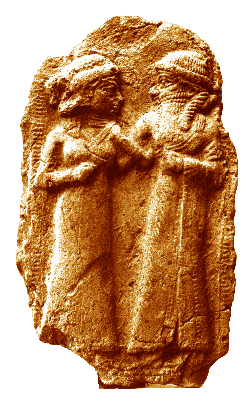
Scholars, including Samuel Noah Kramer and Jeremy Black, have extensively analyzed the ritualistic context of the poem. It was part of an annual ceremony known as the "sacred marriage," a vital rite performed to ensure the fertility of the land and the fecundity of the people for the coming year. In this ritual, the king, representing the mortal realm, would symbolically marry and mate with a priestess, who embodied the goddess Inanna, the Sumerian deity of love, procreation, and war.
Kramer elaborates on this crucial function:
"Once a year, according to Sumerian belief, it was the sacred duty of the ruler to marry a priestess and votary of Inanna, the goddess of love and procreation, in order to ensure fertility to the soil and fecundity to the womb. The time-honored ceremony was celebrated on New Year’s day and was preceded by feasts and banquets accompanied by music, song, and dance. The poem inscribed on the little Istanbul clay tablet was in all probability recited by the chosen bride of King Shu-Sin in the course of one of these New Year celebrations." (Kramer, pp. 245-246)
This ritual was not a casual affair but a solemn and joyous event, central to the religious and social fabric of Sumerian society. It involved elaborate feasts, music, song, and dance, culminating in the sacred union. The recitation of "The Love Song for Shu-Sin" by the "chosen bride" would have been a powerful, public declaration, invoking divine blessing through human intimacy.
Scholarly Interpretations and the Divinity of Kings
Jeremy Black, another respected scholar of Mesopotamian texts, concurs with Kramer’s interpretation, further elucidating the poem’s significance within the broader context of Sumerian kingship and religious belief:
"This is one of several love songs composed for this king which articulate a belief in his very close and personal relationship with the goddess of love. In some songs of this type, the king’s name seems to have been merely substituted for that of Dumuzi [Inanna’s celestial lover in myth]. Almost certainly they were performed in the context of certain religious rituals which have been referred to as the `sacred marriage’ but the precise details are unknown. The belief that the king could in some sense actually have sexual intercourse with the goddess is intimately connected to the belief in the divinity of the kings of this period." (Black, pp. 88-89)
Black’s insights highlight the fascinating theological and political dimensions of the ritual. The king, Shu-Sin, was not merely a ruler but was perceived to have a unique, almost divine, connection with Inanna. The "sacred marriage" ritual, whether a literal or symbolic sexual union with a priestess embodying the goddess, reinforced the king’s authority and his role as a mediator between the human and divine realms. It solidified the belief in the divinity of the kings of this period, a concept vital for maintaining social order and legitimizing royal power. The substitution of Shu-Sin’s name for Dumuzi, Inanna’s mythical lover, further underscores the king’s elevated status and his symbolic alignment with divine figures.
A Blend of Devotion and Deep Personal Affection
Despite its overarching ritualistic and political functions, "The Love Song for Shu-Sin" retains a profoundly personal and affectionate tone. Spoken in the female voice, the poem is a tender address from a bride to her beloved "Bridegroom" and "Lion," celebrating his beauty and expressing deep desire. Lines such as "Goodly is your beauty, honeysweet" and "My precious caress is more savory than honey" evoke a powerful sense of intimacy and sensual appreciation.
This dual nature – a sacred rite performed for communal prosperity and a deeply felt expression of individual romantic and erotic love – makes the poem particularly compelling. It demonstrates that even within the strictures of ancient religious practice, there was ample room for the expression of profound human emotion, a universal experience that transcends cultural and temporal boundaries. The poem serves as a powerful reminder that the personal and the public, the sacred and the profane, were often intricately interwoven in ancient societies.
The Reign of Shu-Sin: History Behind the Ancient Verses
The king at the heart of this ancient love poem, Shu-Sin, was a significant figure in the Ur III period, a time of considerable political and cultural flourishing in Mesopotamia. Understanding his reign provides crucial context for the poem’s creation and its societal role.
A King Amidst Transition
Shu-Sin reigned as king of Ur from approximately 2037 to 2028 BCE, during the late stages of the Ur III dynasty (circa 2112 to circa 2004 BCE). He was the younger son of Shulgi of Ur (reigned 2094 to circa 2046 BCE), one of the most powerful and influential kings of the period, known for his extensive administrative reforms and cultural patronage. Shu-Sin ascended to the throne following the death of his older brother, Amar-Suen (reigned circa 2046 to circa 2037 BCE), who tragically succumbed to a scorpion bite.
While perhaps not as historically celebrated or impactful as his grandfather, Ur-Nammu (reigned circa 2112-2094 BCE), the founder of the Ur III dynasty, or his formidable father Shulgi, Shu-Sin proved to be a capable and respected monarch. His reign was characterized by efforts to maintain the stability and territorial integrity of the kingdom amidst increasing external threats, particularly from nomadic groups along the borders. He initiated significant defensive projects, including the construction of a massive wall known as the "Amorite Wall" to protect Sumer from encroaching Amorite tribes. These actions highlight his strategic foresight and commitment to his people’s security.
Shu-Sin’s Literary Legacy
Shu-Sin was not only an effective ruler but also a figure who captured the imagination of his subjects and subsequent generations, becoming a popular character in ancient Mesopotamian literature. Scholar Stephen Bertman notes this enduring legacy:
"Besides this poem, ‘Shu-Sin was also the male lead in a series of erotic poems in Akkadian written in dialogue form similar to the later biblical Song of Songs’" (Bertman, p. 105).
This detail is particularly striking. It suggests that Shu-Sin, or at least his persona, was consistently associated with themes of love and desire in ancient Mesopotamian literary traditions. The existence of multiple erotic poems featuring him underscores the cultural significance of romantic and sensual expression in Sumerian and Akkadian societies. It also reinforces the idea that Mesopotamian scribes were indeed crafting "first drafts" of influential literary forms and themes long before they appeared in other renowned works like the Bible. This rich literary environment of the Ur III period, with its emphasis on royal hymns and love poetry, provides the perfect backdrop for the creation of "The Love Song for Shu-Sin."
Reshaping History: The Profound Impact of Mesopotamian Discoveries
The archaeological endeavors in Mesopotamia during the 19th and 20th centuries did more than just unearth ancient artifacts; they triggered a seismic shift in how humanity understood its own past. The implications of these discoveries, particularly the textual evidence, continue to resonate in academic and public spheres alike.
Challenging Biblical Scholarship and Western Narratives
Perhaps the most immediate and profound impact was on biblical scholarship. For centuries, the Bible was considered not only a sacred text but also the primary, often sole, historical record of the ancient Near East. Its narratives were believed to be original and chronologically foundational. The discovery and translation of Mesopotamian cuneiform texts, however, revealed a complex web of cultural exchange and literary influence that preceded and informed many biblical stories. The realization that accounts like the Flood and the Fall of Man had older Mesopotamian parallels forced a radical re-evaluation of biblical chronology, authorship, and originality. This was met with both resistance and acceptance within academic circles, ultimately leading to a more nuanced and historically informed approach to biblical studies.
Beyond biblical scholarship, these discoveries challenged a prevailing Eurocentric view of history that often positioned Greco-Roman and Judeo-Christian traditions as the starting points of sophisticated civilization. Mesopotamia, once a shadowy land of myth, emerged as a vibrant, highly advanced civilization, pioneering writing, law, astronomy, mathematics, and literature, thus expanding the recognized scope of human achievement and pushing back the timeline of complex societies.
Mesopotamia: Cradle of World Literature
The vast corpus of cuneiform texts, including "The Love Song for Shu-Sin," firmly established Mesopotamia as the true cradle of world literature. These ancient tablets contain the first known forms of epic poetry (like the Epic of Gilgamesh), legal codes (like Hammurabi’s Code), wisdom literature, myths, and, crucially, expressions of human emotion and experience. The "Love Song for Shu-Sin" exemplifies this rich literary heritage, providing the earliest known articulation of romantic love and passion in written form. It demonstrates that the human capacity for complex emotional expression through art and literature is deeply ancient, not a modern development. This revelation profoundly deepened our understanding of the universal aspects of the human condition and the enduring power of storytelling.
Enduring Echoes: Humanity’s Shared Experiences
The enduring legacy of "The Love Song for Shu-Sin" and other Mesopotamian texts lies in their ability to connect modern audiences with the aspirations, fears, and joys of ancient peoples. The poem, with its tender words and fervent declarations, speaks to the timeless nature of love, desire, and the quest for connection. It underscores that across millennia, humans have grappled with similar emotions and sought similar comforts. The ritualistic context of the poem also highlights universal human concerns: the desire for fertility, prosperity, and the continuity of life, intrinsically linked to divine favor and communal well-being.
The Ongoing Quest for Understanding
The discovery and interpretation of "The Love Song for Shu-Sin" are not merely historical footnotes but represent an ongoing journey of discovery. Scholars continue to translate, analyze, and contextualize the vast number of unread or partially understood cuneiform tablets. Each new translation adds another piece to the intricate puzzle of ancient history, continually enriching our understanding of the origins of human civilization, literature, and thought. These efforts ensure that the voices of ancient Mesopotamia, including the passionate voice of the bride in "The Love Song for Shu-Sin," continue to resonate, reminding us of the profound depth and complexity of our shared human story.
Text of the Poem (Translated by Samuel Noah Kramer):
Bridegroom, dear to my heart,
Goodly is your beauty, honeysweet,
Lion, dear to my heart,
Goodly is your beauty, honeysweet.
You have captivated me, let me stand tremblingly before you.
Bridegroom, I would be taken by you to the bedchamber,
You have captivated me, let me stand tremblingly before you.
Lion, I would be taken by you to the bedchamber.
Bridegroom, let me caress you,
My precious caress is more savory than honey,
In the bedchamber, honey-filled,
Let me enjoy your goodly beauty,
Lion, let me caress you,
My precious caress is more savory than honey.
Bridegroom, you have taken your pleasure of me,
Tell my mother, she will give you delicacies,
My father, he will give you gifts.
Your spirit, I know where to cheer your spirit,
Bridegroom, sleep in our house until dawn,
Your heart, I know where to gladden your heart,
Lion, sleep in our house until dawn.
You, because you love me,
Give me pray of your caresses,
My lord god, my lord protector,
My Shu-Sin, who gladdens Enlil’s heart,
Give my pray of your caresses.
Your place goodly as honey, pray lay your hand on it,
Bring your hand over like a gishban-garment,
Cup your hand over it like a gishban-sikin-garment
UR, MESOPOTAMIA – Millennia before modern legal systems and diplomatic protocols, the ancient Sumerians grappled with the universal challenge of difficult neighbors and escalating disputes. Unearthed
LONDON, UK – Nearly a decade after its inception, a beloved exploration of humanity’s shared myths and legends is returning to its original vision. Authors Dee Dee Chainey and Willow Winsham are set t
ATHENS, GREECE – In the annals of Greek mythology, few figures command as much admiration and scholarly intrigue as Penelope, the formidable queen of Ithaca, wife of the resourceful Odysseus, and moth




Leave a Comment