
The Architect of the Subconscious: Exploring the Provocative Surrealism of Alfred De Angelo
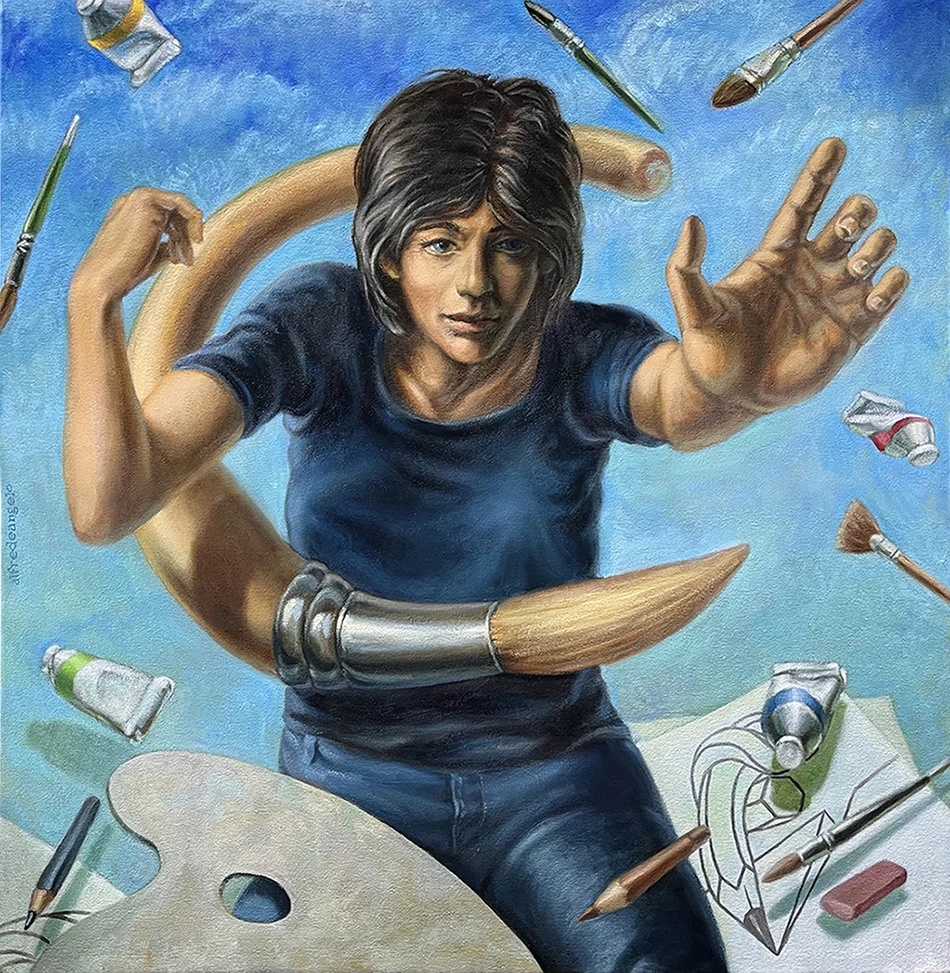
In the contemporary art landscape, where the line between digital artifice and traditional mastery frequently blurs, the work of Alfred De Angelo stands as a testament to the enduring power of the hand-painted surreal. His canvases do not merely present images; they function as sophisticated portals into a world defined by what critics describe as "provocative beauty." Delineated with a technical fluency that betrays a rigorous academic background, De Angelo’s portfolio challenges the viewer to move beyond the surface of the canvas and into the deeper, often unsettling, recesses of the human psyche.
Main Facts: The Aesthetic of Beguilement and Mastery
Alfred De Angelo has carved a unique niche in the neo-surrealist movement. His work is characterized by a remarkable degree of expertise, blending the traditional techniques of the Old Masters with a modern, psychological edge. The primary objective of his work, as evidenced by his body of paintings, is to transport the viewer into a sensual world that balances on the edge of the familiar and the alien.
The "sensual world" mentioned in critical reviews of De Angelo’s work refers to more than just the tactile quality of his paint or the subjects depicted; it refers to a total sensory immersion. His images are known to "beguile or bewilder," a duality that is central to the surrealist tradition. While the technical execution is flawless—characterized by a remarkable fluency in form and light—the subject matter often pushes against the boundaries of logical understanding. This creates a cognitive dissonance in the viewer, forcing a departure from "well-worn patterns of thought."
Key Characteristics of De Angelo’s Work:
- Technical Fluency: A high level of draftsmanship and painterly skill that lends a sense of reality to impossible scenes.
- Provocative Beauty: Use of aesthetic "hooks" to draw the viewer in before presenting more complex or confusing themes.
- The "Private Vocabulary": A recurring set of symbols and motifs that represent the artist’s subjective experiences.
- Psychological Disruption: A deliberate attempt to delight and confuse, allowing the viewer to "press against the limits of their understanding."
Chronology: The Path to Modern Surrealism
The development of Alfred De Angelo’s artistic voice is rooted in some of the United States’ most prestigious art institutions. His journey reflects a deep commitment to the craft, moving from the foundational rigor of undergraduate study to the conceptual refinement of a master’s program.
The Formative Years: Massachusetts College of Art (BFA)
De Angelo’s academic career began at the Massachusetts College of Art (MassArt). Here, he would have been exposed to the high standards of the Boston art scene, focusing on the fundamentals of Fine Arts. This period was likely where he developed the "remarkable fluency" that defines his current work. The BFA experience provided the technical toolkit—anatomy, color theory, and composition—necessary to render surrealist visions with the clarity of a photograph or a lucid dream.

Conceptual Refinement: Rhode Island School of Design (MFA)
Following his undergraduate success, De Angelo attended the Rhode Island School of Design (RISD), widely considered one of the top art and design schools in the world. Earning a Master of Fine Arts (MFA) from RISD is a mark of significant achievement, indicating that De Angelo moved beyond mere representation into the realm of conceptual depth. It was likely during his time at RISD that he began to develop his "private vocabulary of images," moving away from the "localized and subjective" and toward a more universal, albeit mysterious, expression of existence.
The Mature Phase: The "ArtistPainter" Era
In his professional career, De Angelo has established a digital presence through his platform, artistpainter.ws, and has become a featured figure in the surrealist community, often highlighted by publications like Surrealism Today. His current phase is marked by a confident exploration of the "essential mystery of existence," where he attempts to look "through" outward appearances rather than merely at them.
Supporting Data: The Technical and Philosophical Framework
To understand De Angelo’s impact, one must look at the technical "data" of his paintings—the way they are constructed to manipulate viewer perception. His work utilizes "provocative beauty" as a strategic entry point. In psychological terms, this is often referred to as the "aesthetic arrest," a moment where the viewer is so captivated by the beauty of an object that their critical faculties are momentarily suspended.
The Role of Technical Expertise
The "fluency" noted by observers is not merely a stylistic choice; it is a prerequisite for successful surrealism. If a surrealist painting is poorly executed, the "impossible" elements feel like mistakes. However, when executed with De Angelo’s level of expertise, the impossible feels inevitable. This technical "data"—the precision of his brushwork and the sophistication of his glazing—allows the viewer to accept the "bewildering" aspects of the work as part of a coherent reality.
Comparative Context: The Contemporary Surrealist Circle
De Angelo does not work in a vacuum. His place in the modern surrealist movement can be better understood by comparing his approach to his contemporaries:

- Jacob Holster: While Holster explores "Painterly AI Aesthetics," using technology to map "human terrain," De Angelo remains rooted in the physical act of painting, offering a more traditional, tactile counterpoint to the digital revolution.
- Christian Quintin: Quintin’s work focuses on the "memory of feeling" and solitude. De Angelo shares this interest in the subjective experience but tends to lean more toward the "sensual" and the "provocative" rather than the purely melancholic.
- Jesús Aguado: Aguado bridges the gap between accessibility and profundity. De Angelo operates in a similar space, using "beauty" as the accessible bridge to "profundity" and "mystery."
Official Responses: The Artist’s Statement as a Manifesto
In his official artist’s statement, Alfred De Angelo provides a rare glimpse into the intellectual engine driving his creativity. He posits that human experience is inherently "localized and subjective," a series of impressions that are often difficult to communicate through standard language.
On the "Private Vocabulary"
"I am continually developing a private vocabulary of images with which I attempt to express different aspects of these experiences," De Angelo states. This indicates that his paintings are not random assortments of strange objects, but rather a coded language. Each recurring motif—whether a specific play of light, a distorted figure, or a symbolic object—serves as a "word" in a sentence that describes a feeling or a memory for which there is no name.
On the "Essential Mystery"
The most profound element of De Angelo’s philosophy is his desire to look "through" outward appearances. He states: "With my surrealist paintings I try to look ‘through’ outward appearances and somehow embody the essential mystery of existence." This aligns him with the metaphysical tradition of surrealism, echoing the sentiments of Giorgio de Chirico or René Magritte, who sought to uncover the hidden reality behind the mundane.
Implications: The Future of the Surrealist Image
The work of Alfred De Angelo has significant implications for the future of contemporary art, particularly in how we value human-made imagery in an age of automation.
The Human Element in a Digital Age
As AI-generated art (like that of the aforementioned Jacob Holster) becomes more prevalent, the value of De Angelo’s MFA-level craftsmanship increases. The "permission to be amazed—and confused" that he grants the viewer is a deeply human interaction. It is a dialogue between the artist’s subconscious and the viewer’s perception. The implication is that "true" surrealism requires a level of subjective, lived experience that an algorithm cannot yet replicate.

Expanding the Limits of Understanding
By "pressing against the limits of their understanding," viewers of De Angelo’s work are engaged in a form of cognitive exercise. His paintings serve as a reminder that art’s primary function is not always to provide answers, but to ask better questions. In a world increasingly driven by data and literalism, De Angelo’s focus on the "essential mystery" provides a necessary counterbalance, encouraging a return to wonder and philosophical inquiry.
Conclusion
Alfred De Angelo remains a formidable figure in modern fine art. Through his academic pedigree, his development of a sophisticated visual language, and his commitment to the "provocative beauty" of the surreal, he continues to provide "doorways" to worlds that are as unsettling as they are enchanting. For those willing to step through, the reward is a deeper connection to the mysterious, sensual, and ultimately inexplicable nature of the human journey.
For further exploration of his portfolio, De Angelo maintains a presence at artistpainter.ws, where the "private vocabulary" of his work continues to evolve and expand.

Leave a Comment