The Architect’s Dilemma: Navigating the Third Wave of Digital Transformation
Executive Summary: The Cyclical Nature of Disruption
In the volatile intersection of finance and technology, few individuals have the vantage point of witnessing three distinct paradigm shifts from the front lines. The trajectory of modern digital commerce has been defined by moments of extreme speculation followed by fundamental restructuring.
The first wave was the consumer internet at the turn of the millennium; the second was the radical pivot to free-to-play (F2P) and mobile gaming in the late 2000s; and the third, currently unfolding, is the integration of blockchain, cryptocurrencies, and Non-Fungible Tokens (NFTs) into the global entertainment ecosystem. Each of these eras shares a common blueprint: a period of "stratospheric valuations" and "Ponzi-adjacent" speculation that obscures a genuine, underlying shift in how value is created and distributed. For industry veterans, the challenge lies in distinguishing the "meme-stock" noise from the "black swan" opportunities that will eventually redefine the global economy.
A Chronology of Disruption: From Dotcom to Decentralization
2000: The Internet Analyst’s Baptism by Fire
At the dawn of the 21st century, the financial world was gripped by "irrational exuberance." Working as an internet analyst at Deutsche Bank, the prevailing atmosphere was one of total transformation led by a new generation of "nerdy" technologists. At the time, the investment landscape was dominated by traditionalists—predominantly middle-aged men—who struggled to grasp how a decentralized network of computers could dismantle century-old retail and media empires.
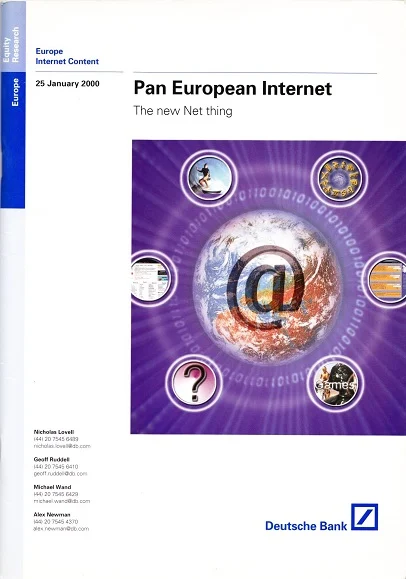
Just three months before the infamous dotcom crash, the consensus was divided between those who saw the internet as a toy and those who saw it as a gold mine. The reality was both. In a major research note published at the time, the advice given to institutional investors was: “Investors should identify those business models and teams that will thrive in the Internet sector, rather than focusing on absolute valuation.”
This philosophy acknowledged that while the "absolute returns" of 99% of dotcom startups would eventually hit zero, the "black swans"—companies like Amazon and eBay—would justify the entire sector’s existence by fundamentally altering human behavior. The analyst’s role was to act as a bridge between the old guard and the new frontier, finding the signal within the valuation noise.
2008: The Free-to-Play Revolution and the Death of the Box
By 2008, the disruption had moved from the general internet to the specifics of the gaming industry. Having transitioned from banking to specialized finance for small-to-medium gaming enterprises, a new pattern emerged. While the "Big Three" publishers (Electronic Arts, Activision, and Eidos) were still focused on $60 retail discs, a quiet revolution was happening in South Korea and Germany.
Browser-based games were proving that "giving the product away for free" was not corporate suicide, but a superior monetization strategy. By tying players to persistent accounts and charging for incremental progress, cosmetics, or virtual currencies, developers created a "Service" model rather than a "Product" model.
This era coincided with Steve Jobs’ announcement of the iPhone and the subsequent App Store, which provided the "rocket fuel" for mobile gaming. In high-level meetings with CEOs like John Riccitiello (EA) and Bobby Kotick (Activision), the tension was palpable. These executives were tasked with steering massive tankers through a narrow strait; they knew the world was changing, but the "hype" of F2P felt antithetical to their established business logic. Once again, the expert’s role was to guide these legacy leaders through the fog of a new technology that seemed, at first glance, to be less profitable than the status quo.
2021: The Blockchain Inflection Point
Thirteen years later, the cycle has repeated. The convergence of blockchain technology, cryptocurrencies, and NFTs has created a third transformational event. Like the previous two, this era is characterized by "Ponzi-schemes" and speculative bubbles where the underlying value is often non-existent.
However, the core tenets of this shift—digital scarcity, true ownership of virtual assets, and decentralized ledgers—echo the early days of the internet and F2P gaming. In 2021, the veteran analyst finds themselves in the position of the "older executive" they once advised. The urge to dismiss the entire sector as "ridiculous" is strong, yet the historical precedent suggests that within the chaos of the "meme-stock" investments, a permanent change to the building blocks of society is taking place.
Supporting Data: The Magnitude of the Shifts
To understand why these shifts are so difficult to navigate, one must look at the data that defined the previous eras and the current one.
| Era | Key Metric | Growth/Impact |
|---|---|---|
| Dotcom (1995-2000) | NASDAQ Composite | Rose 400% between 1995 and 2000, then fell 78% from its peak. |
| F2P/Mobile (2008-2020) | Global Gaming Revenue | Mobile gaming grew from near-zero in 2008 to $86.3 billion in 2020, representing over 50% of the total market. |
| Web3/NFTs (2021) | NFT Sales Volume | Surged from $94.9 million in 2020 to $24.9 billion in 2021 (DappRadar). |
The data illustrates a recurring theme: extreme volatility is the precursor to mass adoption. In the F2P era, critics argued that virtual items had no "real" value. Today, the global market for "skins" and in-game cosmetics is estimated at $40 billion annually. This validates the psychological shift that digital assets—whether a "blue hat" in a game or an NFT on a blockchain—serve as vital forms of self-expression, comparable to luxury cars or designer clothing in the physical world.
Official Responses: Industry Sentiment and Institutional Hesitation
The response from the "traditional" gaming establishment to the 2021 blockchain surge has been a mixture of experimental curiosity and fierce public backlash.
- Electronic Arts (EA): CEO Andrew Wilson initially described NFTs and play-to-earn games as "the future of our industry," though he later moderated this stance following player pushback, citing the need for "better execution" and "value proposition."
- Ubisoft: The French publisher was one of the first major players to integrate NFTs via its "Quartz" platform. The move was met with significant hostility from the core gaming community, illustrating the friction between technological potential and consumer sentiment.
- Valve (Steam): In a stark contrast, Valve banned all games that incorporate blockchain or NFTs from its Steam platform, citing concerns over the lack of regulation and the potential for fraud.
- The Developer Community: Many grassroots developers remain skeptical, viewing the current NFT craze as "technology looking for a problem to solve," similar to how traditional developers viewed F2P in 2008 as "ruining the art of game design."
Implications: The Future of Digital Value
The fundamental takeaway from these three career-defining moments is that permanence is the ultimate goal of technology.
- The Internet made information permanent and accessible.
- Free-to-Play made the player-developer relationship permanent and service-based.
- Blockchain aims to make digital ownership permanent and independent of a single corporation.
The Evolution of Self-Expression
For those who understand F2P, the concept that a digital item has value is already proven. The next step is the "Permanence of the Blockchain." If a player spends $1,000 on an avatar in a centralized game, that value disappears if the game server shuts down. The blockchain offers a theoretical solution to this "evanescence of value."
The Transition of the "Old Guard"
The most profound implication of the 2021 shift is the changing of the guard. The analysts who were the "young rebels" in 2000 and 2008 are now the institutional voices. They face a unique psychological hurdle: the "Curse of Knowledge." Having seen bubbles burst before, they are more likely to see the Ponzi elements than the revolutionary ones.
However, as the author notes, the buildings blocks of society and gaming are being altered once again. The "older investor" must now do the hard work of looking beneath the "meme-stock" surface. The opportunities lie not in the "hot potato" of speculative trading, but in the infrastructure that will allow the next generation to value their digital lives as much as—if not more than—their physical ones.
Conclusion
The journey from a Deutsche Bank research desk in 2000 to the blockchain-integrated world of 2021 reveals a singular truth: technology always moves faster than our ability to value it accurately. We are currently in the "1995" of the blockchain or the "2003" of Free-to-Play—a time of confusion, overvaluation, and skepticism. But if history is any guide, the "Ponzi-nonsense" of today will be the foundational infrastructure of tomorrow. The challenge, as always, is surviving the crash to see the future.