The Digital Vanguard: How a VRChat Independent Production Toppled Giants at the Emmy Awards

In an industry often defined by the colossal budgets of streaming titans and the marketing might of global gaming franchises, the 76th Creative Arts Emmy Awards delivered a watershed moment for the future of immersive storytelling. The victory of Uncanny Alley: A New Day in the category of Outstanding Emerging Media Program represents more than just a win for a small creative team; it signals a fundamental shift in how the Academy of Television Arts & Sciences perceives the intersection of performance, technology, and audience agency.
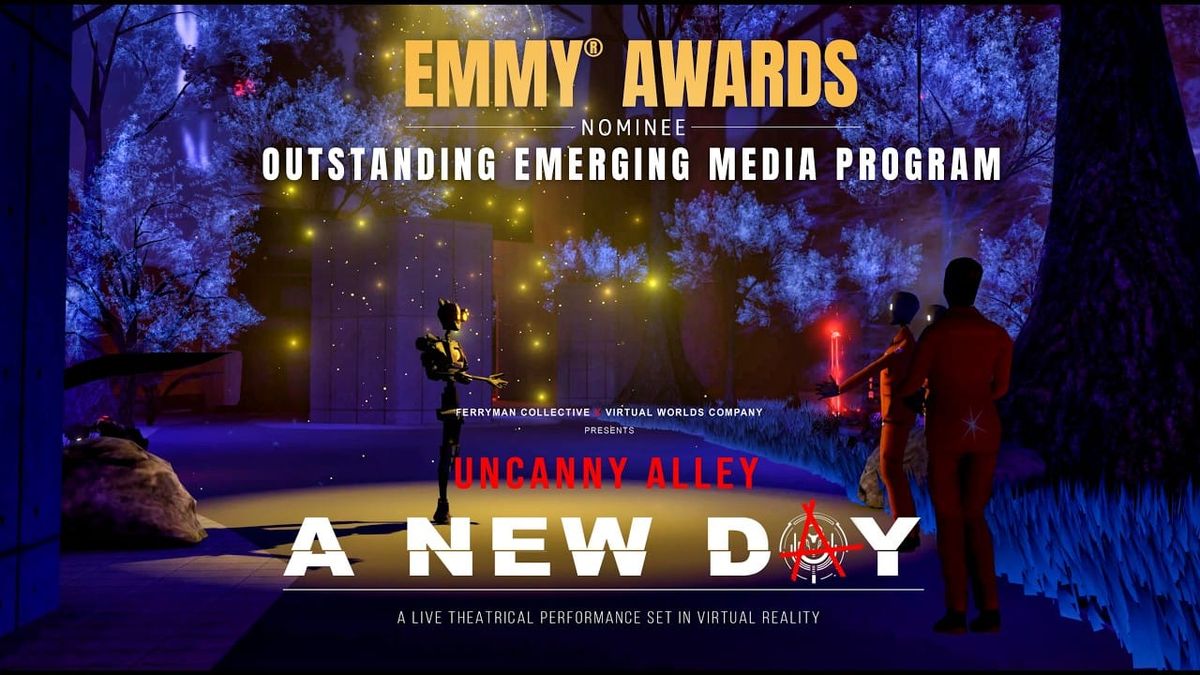
Produced by the Ferryman Collective and Virtual Worlds Company, Uncanny Alley: A New Day is a live, immersive theatrical experience built entirely within the social VR platform VRChat. Its triumph over high-profile nominees—specifically Blumhouse Enhanced Cinema (a collaboration between horror powerhouse Blumhouse and NBCUniversal) and The World of Fallout (the promotional juggernaut from Amazon MGM Studios and Bethesda)—marks a "David vs. Goliath" narrative that has sent ripples through the XR (Extended Reality) and traditional media sectors alike.
Main Facts: The Triumph of the Independent Creator
The Emmy for Outstanding Emerging Media Program is designed to honor excellence in media that pushes the boundaries of traditional television, utilizing interactive, immersive, or innovative technologies. This year, the competition was particularly fierce, featuring entries backed by the deepest pockets in entertainment.
The Contenders
The nomination list reflected the current landscape of high-end digital marketing and transmedia storytelling:
- The World of Fallout (Amazon MGM Studios): An expansive digital companion to the critically acclaimed television series, designed to deepen the lore of the post-apocalyptic wasteland.
- Blumhouse Enhanced Cinema (NBCUniversal/Blumhouse): A sophisticated interactive layer for horror enthusiasts, blending cinematic tension with digital engagement.
- Uncanny Alley: A New Day (Ferryman Collective/Virtual Worlds Company): A live-actor-driven, cyberpunk theatrical experience hosted in a free-to-access social VR space.
The Winner’s Profile
Uncanny Alley: A New Day is the brainchild of the Ferryman Collective, a non-profit theatre company that has spent the last several years pioneering "Live VR Theatre." Unlike pre-recorded 360-degree videos or scripted AI interactions, Uncanny Alley features real actors performing in real-time, wearing motion-capture suits and VR headsets from their respective homes around the world. The experience is hosted on VRChat, a platform traditionally known for user-generated content and social hangouts, rather than high-concept professional drama.
Chronology: From Venice Immersive to the Emmy Stage
The journey of Uncanny Alley to the Emmy podium was paved with accolades from the most prestigious film and technology festivals in the world. Its success was not an overnight phenomenon but the result of a multi-year effort to refine the medium of spatial storytelling.
The Premiere: Venice International Film Festival
The project first gained international attention at Venice Immersive, the XR-focused branch of the Venice International Film Festival. As one of the world’s oldest and most prestigious film festivals, Venice has become a crucial gatekeeper for high-art VR. The premiere of Uncanny Alley established the project as a serious contender in the world of digital arts, moving beyond the "tech demo" phase into a fully realized narrative work.
The Festival Circuit (2023–2024)
Following its success in Venice, the production embarked on a rigorous global tour:
- SXSW (South by Southwest): The project was showcased in Austin, Texas, where it resonated with the convergence of tech and indie culture.
- Raindance Immersive: A staple of the London indie scene, Raindance provided a platform for the production to engage with the European immersive community.
- NewImages Festival: Hosted in Paris, this festival further cemented the project’s reputation for technical and narrative innovation.
- AWE (Augmented World Expo): Here, the technical achievements of the Ferryman Collective were highlighted among industry professionals focusing on the future of spatial computing.
The Climax: The Emmy Win
In late 2024, the Academy announced that the small-scale VRChat production had defeated the corporate giants. The win validated the Ferryman Collective’s mission: to prove that emotional resonance and innovative "liveness" are more valuable to the future of media than raw production budget.
Supporting Data: The Scale of the "VRChat Theatre" Movement
While Uncanny Alley may seem like a niche production to those outside the XR bubble, the data suggests a massive and growing audience for this type of content.
Audience Reach and Impact
The creators, Ferryman Collective and Virtual Worlds Company, have reported staggering engagement metrics across their suite of VRChat projects:
- Total Visitors: Nearly 750,000 visitors have cycled through their various VRChat worlds.
- The "Severance Theory" Legacy: Before Uncanny Alley, the team produced The Severance Theory: Welcome Home, which also garnered critical acclaim and demonstrated that audiences were willing to pay for ticketed, live VR performances.
- Accessibility: By choosing VRChat as their venue, the creators made the experience accessible to anyone with a PC or a Meta Quest headset, removing the high barrier to entry often associated with bespoke "location-based" VR installations.
Narrative Complexity
Uncanny Alley: A New Day is set in a dystopian cyberpunk world. The experience is structured as a "dark ride," but one where the tracks are invisible and the passengers are active participants.
- The Plot: Audience members begin the experience in a prison cell, having been arrested for protesting a mandatory "New Day" software update—a meta-commentary on the loss of digital autonomy.
- The Mechanics: A hacker character named Ghost recruits her friend Puck to initiate a jailbreak.
- Interactivity: This is not a passive viewing. Audience members speak directly to the characters, and the actors respond in character, improvising based on the audience’s input. While the overarching narrative beats remain consistent, the dialogue and specific interactions are unique to every single performance.
Official Responses: A New Era for Performers
In statements following the win, the creators emphasized the human element of their digital work. The Ferryman Collective has frequently championed the idea that VR is not a replacement for theatre, but a new type of theatre that allows for global collaboration.
"Winning an Emmy is a surreal validation of years of work in a medium many people still don’t quite understand," a spokesperson for the collective noted in a post-ceremony briefing. "We aren’t just making games; we are creating a new space for human connection where the distance between the performer and the audience is zero, even if they are thousands of miles apart."
Industry analysts have also weighed in. "The Academy’s choice is a clear signal," says media consultant Marcus Thorne. "They chose the project that utilized the medium’s unique properties—presence, agency, and live interaction—rather than the projects that used the medium as an extension of a marketing department for a TV show. It’s a win for the ‘native’ VR creators."
Implications: The Future of Media and the "Spatial Turn"
The Emmy win for Uncanny Alley: A New Day carries several profound implications for the future of the entertainment industry.
1. The Democratization of High-End Production
This win proves that a small non-profit can compete with Amazon and NBC. In the realm of emerging media, a brilliant concept executed with deep understanding of the platform can outweigh a $100 million marketing budget. This may encourage more independent creators to view VR as a viable path to mainstream recognition.
2. The Evolution of "Liveness"
Traditional television is static. Even "interactive" shows like Black Mirror: Bandersnatch are ultimately comprised of pre-recorded branches. Uncanny Alley introduces "Liveness" to the Emmy categories in a way we haven’t seen before. It suggests that the Academy is ready to recognize the skill involved in live, digital improvisational performance.
3. VRChat as a Professional Venue
For years, VRChat was viewed by the general public as a chaotic "wild west" of the internet. This Emmy win provides the platform with a new level of cultural legitimacy. It demonstrates that VRChat can function as a digital Broadway—a venue for professional-grade, award-winning art.
4. The Meta-Narrative of Digital Autonomy
The story of Uncanny Alley—fighting against a forced "New Day" update—is a poignant reflection of our current relationship with technology. The fact that this message won an Emmy suggests a growing appetite for stories that critique our digital lives from within the very technology they examine.
Conclusion
Uncanny Alley: A New Day has done more than just add a trophy to the Ferryman Collective’s shelf. It has provided a roadmap for the future of the Outstanding Emerging Media Program category. As we move further into the era of spatial computing, the lines between "watching a show" and "being in a show" will continue to blur. By honoring a project that prioritizes human performance and audience agency over corporate synergy, the Emmy Awards have acknowledged that the next great leap in storytelling isn’t just about better pixels—it’s about better presence.
For those curious to witness the future of theatre, the world remains open in VRChat, serving as a living monument to the day the underdogs of the virtual world took home television’s highest honor.