The Undying Legacy: A Deep Dive into "Century of the Vampire" Project’s Definitive Tier List
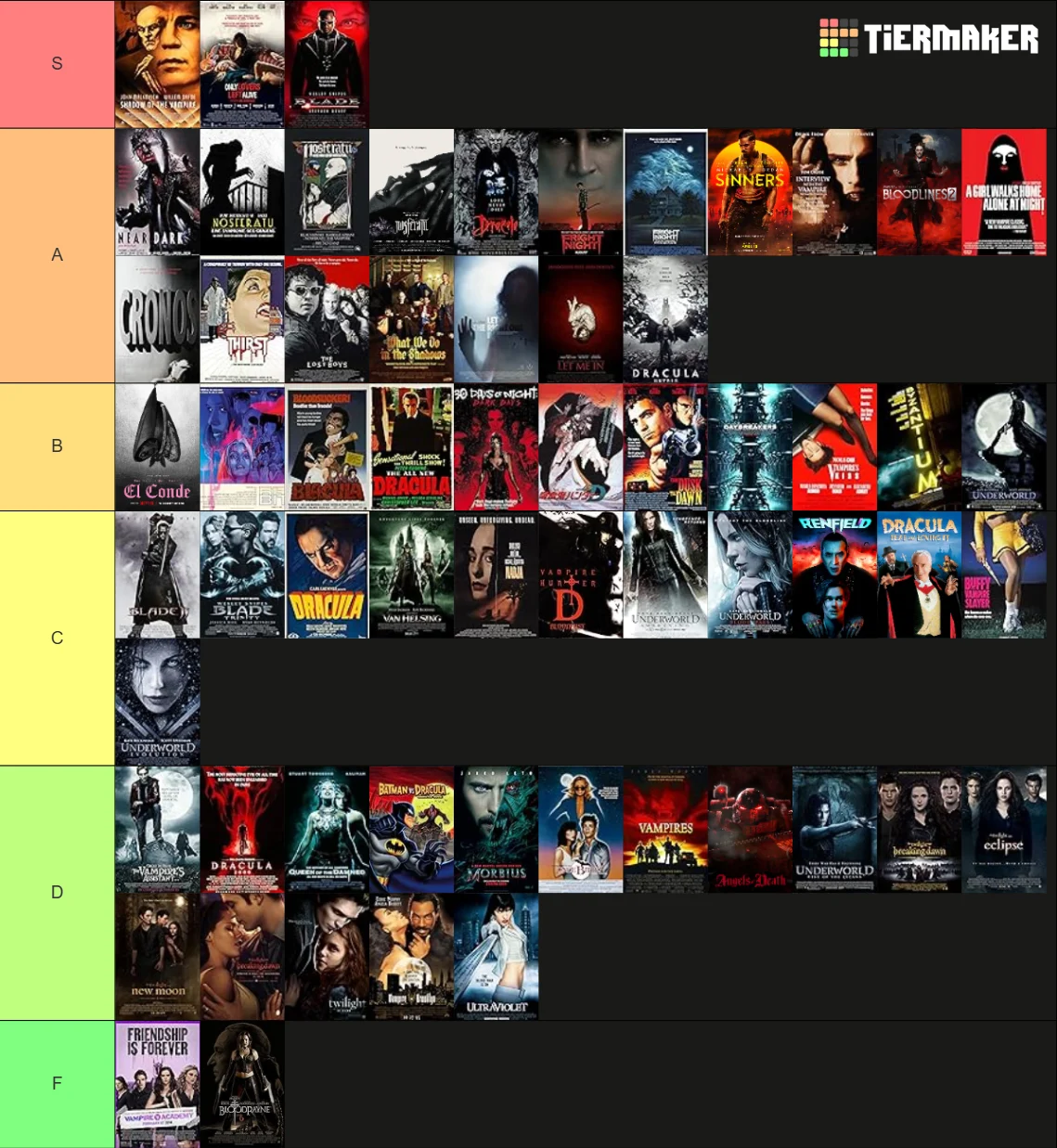
Los Angeles, CA – [Date of Publication] – After an exhaustive eighteen-month odyssey through the annals of cinematic vampirism, the "Century of the Vampire" project has culminated in a definitive, meticulously categorized tier list of 62 films. This ambitious endeavor, spanning from foundational classics to contemporary releases, aimed to capture the essence of modern Western vampire cinema, dissecting its peaks, valleys, and surprising detours. The resulting S-to-F tier ranking offers not just a critical assessment of individual films but a broader commentary on the evolution and challenges of the vampire genre across nearly a century.
The project, spearheaded by a dedicated film critic, embarked on a mission to review a diverse selection of vampire narratives, seeking to understand what makes these bloodsucking entities enduring figures in popular culture. While acknowledging the impossibility of an "exhaustive" survey given the vast global output of vampire films, the selection focused on culturally impactful English-language and key international productions. The final analysis, accompanied by individual film reviews, provides an invaluable resource for aficionados and casual viewers alike, offering a structured framework for appreciating (or lambasting) the genre’s myriad interpretations.
The Journey Through Shadow: A Project’s Chronology and Methodology
The "Century of the Vampire" project commenced with an ambitious goal: to systematically evaluate 62 distinct cinematic portrayals of vampires. Over approximately 18 months, each film was subjected to rigorous review, leading to its placement within a hierarchical tier system ranging from "S" (exemplary) to "F" (failure). The methodology adopted a modern tier-list approach, a popular format for comparative analysis in various media.
Initial expectations for the distribution of films across these tiers anticipated a classic bell curve, with a few masterpieces at the S-Tier, a handful of abysmal failures at the F-Tier, and the vast majority settling into the middle ground of B and C. This hypothesis largely held true, confirming the general mediocrity that often characterizes genre output while highlighting the rare gems and truly regrettable missteps. The critic meticulously defined the nuances between the central tiers: B-Tier films were deemed "mediocre in a positive fashion – fun-bad or fun or almost-good," embodying an enjoyable imperfection, whereas C-Tier films were simply "just mediocre," lacking significant redeeming qualities or notable flaws.
This granular approach allowed for a nuanced discussion of each film’s merits and demerits, moving beyond simplistic good/bad dichotomies. The project’s commitment to detail meant that for each tier, the analysis spotlighted the highest-ranked film, the lowest-ranked film, and the entry whose placement proved most surprising to the critic. This framework ensured that the tier list was not merely a subjective ranking but a thoughtful exploration of genre conventions, thematic depth, and filmmaking craft. The project also notably integrated a video game, Vampire: The Masquerade Bloodlines 2, reflecting the expanding presence of vampires across different media.
Supporting Data: A Comprehensive Tier-by-Tier Analysis
The heart of the "Century of the Vampire" project lies in its detailed tier breakdowns, revealing the criteria that elevate a film to iconic status or consign it to cinematic purgatory.
S-Tier: Epitomes of Modern Vampire Cinema
The S-Tier, reserved for the absolute pinnacle of modern Western vampire cinema, comprises three films, each exemplifying a distinct facet of the genre’s potential. These films are not just excellent; they are foundational, setting benchmarks that remain largely unmatched.
- Blade (1998): The Action Blockbuster Standard. This film remains the gold standard for vampires as action-science fiction monsters. Its visceral fight choreography, compelling anti-hero, and innovative blend of horror with martial arts established a high-water mark that, according to the critic, no subsequent film—not even from Marvel itself—has dared to truly imitate. Blade‘s influence is undeniable, yet its specific niche within the superhero landscape has proven difficult to replicate, leaving it a unique and powerful entry.
- Shadow of the Vampire (2000): The Apex of Intellectual Horror. This meta-horror masterpiece is lauded as arguably the scariest film of the entire collection. It eschews cheap jump scares for a pervasive sense of dread, crafting a narrative where the line between method acting and genuine monstrosity blurs. The film’s brilliance lies in its ability to evoke intellectual and atmospheric horror, demonstrating that true terror often stems from psychological unease and moral ambiguity rather than overt gore. It represents the genre’s capacity for sophisticated, thought-provoking fear.
- Only Lovers Left Alive (2013): The Social and Sexy Vampire Reimagined. At the opposite end of the spectrum, Jim Jarmusch’s Only Lovers Left Alive redefines vampires as melancholic, cultured, and inherently social beings. While hunting and killing occur, the film prioritizes mood, character, and existential musings over traditional horror tropes. Its placement here highlights the genre’s versatility, proving that vampire narratives can thrive as "hangout cinema," exploring themes of immortality, art, and love with a seductive, understated elegance. The critic notes this as the most surprising S-Tier entry, given initial low expectations, proving the film’s unique ability to transcend conventional genre boundaries.
A-Tier: Mainstays and Underrated Gems
The A-Tier represents a strong collection of highly competent and influential vampire films, including several genre mainstays and a few unexpected triumphs. This tier showcases the breadth of quality storytelling within the vampire narrative.
Notable entries include Francis Ford Coppola’s lavish Bram Stoker’s Dracula (1992), Guillermo del Toro’s atmospheric Cronos (1992), Park Chan-wook’s provocative Thirst (2009), Joel Schumacher’s iconic The Lost Boys (1987), both haunting adaptations of Let the Right One In (2008) and Let Me In (2010), Neil Jordan’s gothic Interview with the Vampire (1994), and all critically examined versions of Nosferatu (1922, 1979, 2024). These films are celebrated for their strong narratives, memorable characters, and significant contributions to the genre’s lore.
The most surprising A-Tier inclusion is Dracula Untold (2014), which the critic champions as the closest the genre has come to a great vampire action flick since the original Blade. Its unfortunate entanglement in the "Dark Universe" franchise overshadowed its genuine merits, particularly Luke Evans’s compelling performance. Conversely, the pinnacle of this tier is declared to be Near Dark (1987), praised for its raw, brutal depiction of vampire life, so intense it nearly warranted an S-Tier placement. Another unexpected but compelling A-Tier entry is the video game Vampire: The Masquerade Bloodlines 2 (2025), recognized for its surprisingly engaging, albeit linear, narrative despite its commercial struggles.
B-Tier: Positive Mediocrity and Enjoyable Flaws
The B-Tier encapsulates films that are "mediocre in a positive fashion," often characterized by strong individual moments or concepts that are hindered by inconsistencies or uneven execution. These are films that, despite their flaws, offer genuine entertainment or intriguing ideas.
Leading this tier is El Conde (2023), a film lauded for its striking individual images and moments, though its overall narrative length and inconsistency prevented it from reaching the A-Tier. From Dusk Till Dawn (1996) is a prime example of a film whose potential is marred by its unevenness; its cult status is largely built on its explosive, action-packed second half, which, if isolated, would be considered A or even S-Tier. However, its "intolerable" initial thirty minutes drag it down. 30 Days of Night (2007) stands as a "rock-solid B-Tier film," appreciated for its mean-spirited horror but somewhat dated by its aggressively 2010s aesthetic. The original Underworld (2003) barely holds its B-Tier position, praised for its commercial success over Blade II, yet frequently teetering on the edge of the C-Tier, highlighting the blurred lines between these middle categories.
C-Tier: Just Mediocre
The C-Tier houses films that are simply "just mediocre," often possessing one or two standout elements that prevent them from falling further but are otherwise unremarkable.
Blade II (2002) exemplifies this tier’s paradoxical nature, with its "freakish bug vampire Nosferatu creatures" receiving high praise for monster design, yet "literally anything else about the movie" pulling it back down to C-Tier. The most surprising entry here is the original Dracula (1931), criticized for being a "very poor adaptation" with excessive focus on the Renfield character, memorable primarily for Bela Lugosi’s iconic performance. Nadja (1994), despite its interesting shots and an enjoyable Renfield, suffers from an unfavorable ratio of compelling moments to "boring flab." Three of the four Underworld sequels anchor the bottom of this tier, with Underworld: Evolution (2006) serving as the firm floor before descending into the D-Tier.
D-Tier: The Dreck and the Redeemable Failures
The D-Tier is home to a significant number of films characterized by their overall poor quality, though some manage to salvage a shred of redeeming value. This tier often represents misfires, misguided attempts, or simply forgettable entries.
Cirque du Freak: The Vampire’s Assistant (2009) earns its spot through John C. Reilly’s valiant but ultimately futile effort to elevate a "bad film." The Batman vs. Dracula (2005) is placed here as a predictable animated feature that delivers exactly what its title promises, without exceeding expectations. The 1990s, a prolific decade for vampire films, also produced considerable "dreck," as evidenced by John Carpenter’s Vampires (1998), Dracula 2000 (2000), and Vampire in Brooklyn (1995). The entire Twilight Saga (2008-2012) resides here, a deliberate collective placement to avoid individual re-evaluation.
Perhaps the most surprising D-Tier entry is Morbius (2022), which, despite its critical lambasting, is credited with having "cool enough" CGI vampire fighting sequences to prevent it from sinking lower. This highlights a nuanced approach to even deeply flawed films, acknowledging that isolated technical merits can provide some "redeeming value." Ultraviolet (2006) marks the bottom of the D-Tier, narrowly avoiding the F-Tier, signifying films that are almost irredeemable.
F-Tier: Unprofessional, Incompetent, and Contemptible
The F-Tier is reserved for the absolute worst, films that represent either a profound lack of craft or a fundamental conceptual failure. For a long time, this tier had only one occupant.
BloodRayne (2005): The Apex of Unprofessionalism. This film held a solitary, infamous position as the "unprofessional, intractable piece of garbage" for an extended period. Criticized for being "too lazy and boring to be repulsive," it embodies a complete failure of filmmaking, further exacerbated by the director’s subsequent controversial work. BloodRayne represents a baseline of incompetence and contemptible execution.
However, it was eventually joined by Vampire Academy (2014). While acknowledging Vampire Academy‘s slightly higher "professionalism" in terms of production values, the critic deems its conceptual foundation "unacceptable in its bones." This film is seen as a "soulless attempt to cash in on Harry Potter" infused with "race science" and conceived solely as "easy money." Its scriptwriting and plotting are described as potentially "more incompetent than BloodRayne," utterly failing to respect the core concept of vampirism, reducing it to a mere branding exercise for a "shitty and boring private school YA story." The film’s egregious flaws, particularly its contempt for its own genre and its ill-conceived narrative, solidify its place at the very bottom of the entire ranking, a testament to how conceptual failure can be even more damaging than technical sloppiness.
Official Responses and Future Trajectories
While the "Century of the Vampire" project represents a singular critical endeavor rather than an official industry report, its detailed analysis serves as a compelling "response" to the evolution of vampire cinema itself. The project implicitly critiques the cycles of innovation and stagnation within the genre, highlighting the industry’s struggle to recapture the magic of early successes or to innovate beyond established tropes. The critic’s reflections on films like Blade versus Marvel’s current inability to integrate the character, or the cautionary tale of the "Dark Universe" around Dracula Untold, offer pointed commentary on studio strategies and the often-detrimental impact of franchise building.
The project also offers an "official response" to the public’s engagement with these narratives. The very existence of a dedicated fan base for films like Dracula Untold or even Morbius (despite its critical reception) underscores the enduring appeal of the vampire archetype, even when poorly executed. The inclusion of Vampire: The Masquerade Bloodlines 2 signals an acknowledgement that "vampires aren’t just movie monsters these days," indicating a broader trend in media consumption. The project hints at future explorations into vampire video games, demonstrating a commitment to understanding the full scope of the vampire’s cultural footprint.
Implications: The Enduring Allure and Challenges of Vampire Cinema
The "Century of the Vampire" project yields several significant implications for understanding the genre. Firstly, it reaffirms the incredible versatility of the vampire archetype. From action heroes to existential philosophers, terrifying monsters to sexy romantic leads, vampires have adapted to virtually every cinematic genre, proving their enduring narrative elasticity. The S-Tier alone showcases this diversity: action-horror, intellectual dread, and contemplative drama.
Secondly, the project highlights the challenges inherent in crafting truly great vampire narratives. The difficulty of making vampires genuinely scary in an era saturated with visceral horror often pushes filmmakers towards intellectual or atmospheric horror, as seen with Shadow of the Vampire. Similarly, the struggle to innovate beyond traditional gothic romance or action-horror can lead to derivative or conceptually flawed films, exemplified by the vast middle tiers and the F-Tier’s "soulless" attempts.
Thirdly, the project underscores the cyclical nature of cinematic trends. The 1990s, despite producing some classics, also churned out considerable "dreck," a pattern that seems to repeat with every generation of vampire films. The rise and fall of the Twilight phenomenon, and its ultimate relegation to the D-Tier, serves as a poignant reminder of fleeting cultural moments.
Finally, the project points towards the future. As vampires transcend traditional film and television, venturing into video games and other interactive media, the critical lens must also expand. The "Century of the Vampire" project, while concluding its cinematic leg, lays the groundwork for a continued, comprehensive examination of these immortal beings across all forms of storytelling, ensuring their legacy will continue to be debated, celebrated, and scrutinized for centuries to come.
For further engagement or feedback, please reach out to [email protected]. Stay updated with our latest analyses by subscribing to our newsletter, and consider supporting our work on Patreon for exclusive content and an ad-free experience.