Thirty Years of the "Working-Class Prince": Edward Burns Returns with "Finnegan’s Foursome"
Introduction: A Career Preserved in Amber
In 1995, a young filmmaker from Long Island named Edward Burns took the Sundance Film Festival by storm. His debut feature, The Brothers McMullen, filmed on a shoestring budget of roughly $25,000, became the ultimate Cinderella story of the 1990s indie boom. Today, nearly three decades later, Burns remains a unique, if somewhat static, fixture in the American cinematic landscape. His latest effort, Finnegan’s Foursome, marks his 16th feature film—a milestone that underscores both his prolific nature and his unwavering commitment to a very specific brand of Irish-American dramedy.
At 58, Burns appears remarkably unchanged. Often described as the "prince of the working-class Irish-American set," he retains the lean, handsome physique and silver-touched ruggedness that made him a star in the mid-90s. However, it is not just his appearance that seems preserved in amber; his filmmaking style, characterized by "shaggy-dog" narratives, talky scripts, and functional aesthetics, remains remarkably consistent. As Finnegan’s Foursome makes its debut on streaming platforms, it serves as a litmus test for the longevity of the "homespun auteur" in an era dominated by high-concept blockbusters and prestige television.
Main Facts: The Premise of "Finnegan’s Foursome"
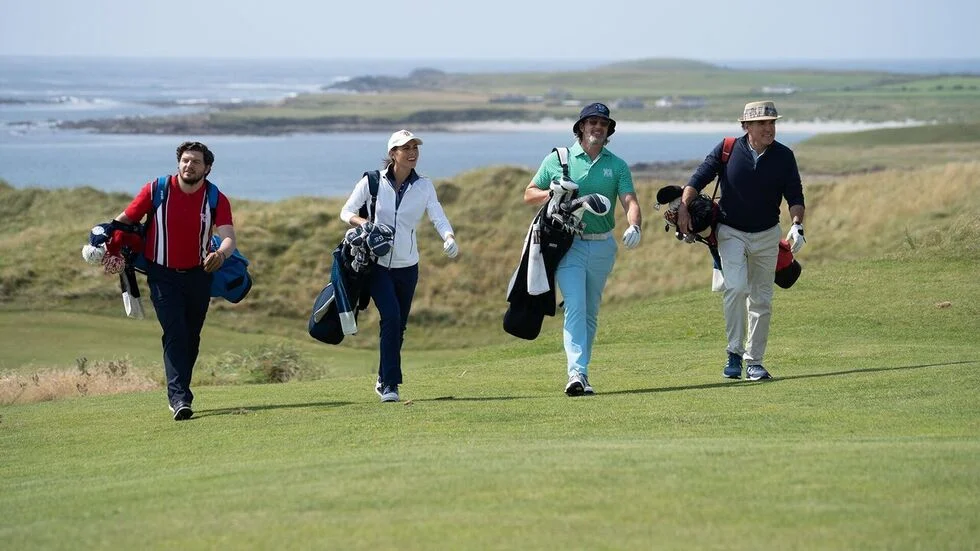
Finnegan’s Foursome is a sports-centric comedy-drama that intertwines the technical obsession of golf with the messy complexities of family inheritance and emotional reconciliation. The film follows the Finnegan family, led by the patriarch Jack (Ian McElhinney), an irascible Irish immigrant who arrived in the United States in 1959. A retired golf instructor, Jack lives in South Carolina, where he hosts the "Finnegan’s Cup"—an annual family tournament that serves as a platform for his blustery storytelling and frequent reminders of his brush with greatness alongside legends like Arnold Palmer and Jack Nicklaus.
The narrative engine is ignited by a freak occurrence: during the tournament, a hole-in-one is struck, and the shock causes Jack to suffer a fatal heart attack. This leads to a classic "dying wish" scenario. The family must travel to Ireland to scatter Jack’s ashes across four specific locations—two of which are fabled golf courses.
The Ensemble Cast
The film features a cast that bridges the gap between Broadway veterans and indie mainstays:
- Edward Burns as Freddy Finnegan: A wealthy clothing entrepreneur with a "samurai man-bun" and significant anger-management issues rooted in a lifetime of seeking his father’s approval.
- Brian d’Arcy James as Teddy Finnegan: Freddy’s older, more temperate brother, a novelist struggling with a severe case of writer’s block.
- Ian McElhinney as Jack Finnegan: The blustery, egomaniacal, yet ultimately warm-hearted father whose presence looms large even after his passing.
- Brian Muller as Frankie: Freddy’s musician son, who bears the brunt of Freddy’s inherited emotional distance.
- Erica Hernandez as Marie: Teddy’s adult daughter, who serves as the audience surrogate, questioning the family’s relentless culture of "ball-busting."
Chronology: The Evolution of the Burns Brand (1995–2024)
To understand Finnegan’s Foursome, one must look at the trajectory of Edward Burns’ career, which has functioned as a parallel narrative to the shifting tides of the American independent film industry.
The Sundance Breakthrough (1995–1996)
The success of The Brothers McMullen (1995) cannot be overstated. It won the Grand Jury Prize at Sundance and grossed over $10 million—an astronomical return on investment. Burns was immediately hailed as the Irish-American answer to Woody Allen. He followed this with She’s the One (1996), a higher-budget affair featuring Jennifer Aniston and Cameron Diaz, which solidified his status as a "crossover" director who could maintain an indie sensibility while working with A-list talent.
The "Crossing Back" Period (2000s–2010s)
Unlike many of his contemporaries who transitioned into big-budget studio filmmaking (such as Steven Soderbergh or Quentin Tarantino), Burns eventually "crossed back" into the indie wilderness. He began experimenting with digital filmmaking and alternative distribution models long before they became industry standards. Films like Nice Guy Johnny (2010) and The Fitzgerald Family Christmas (2012) saw him returning to his roots: low budgets, ensemble casts, and stories centered on the domestic friction of the New York tri-state area.
The Streaming Era and "Finnegan’s Foursome" (2020–Present)
In the current landscape, Burns has found a sustainable niche in the streaming world. Finnegan’s Foursome represents the culmination of this journey. It is a film that feels more like a comfortable television episode than a cinematic event—a "minor indie movie" that has found its natural habitat on digital platforms.
Supporting Data: Narrative Themes and Technical Execution
The "Golf as Therapy" Trope
The film leans heavily into the "geometric majesty of the links." Working with cinematographer Jeff Muhlstock, Burns captures the lush, sweeping landscapes of the Irish coast. However, the film struggles with the "dramatic Zen" typical of sports movies. In classics like Tin Cup, the audience is invested in the protagonist’s victory. In Finnegan’s Foursome, the stakes are internal. The "Finnegan’s Cup" is less about the score and more about whether Freddy can dismantle the "ogre of resentment" he harbors toward his father.
Dialogue and Tone
The script is characterized by what critics describe as "on-the-nose" dialogue. Lines such as, “It’s not about the clubs, little brother, it’s about the man who’s swingin’ ’em,” highlight the film’s penchant for cornball sentimentality. The central conflict—the "ball-busting" between Freddy and Teddy—serves as the primary vehicle for character development. While this creates a sense of lived-in authenticity for anyone familiar with Irish-American family dynamics, it also risks becoming repetitive for the casual viewer.
The "Privileged Problem" Critique
A recurring criticism of Burns’ later work is the perceived lack of high stakes. Freddy’s primary trauma is that his father spent too much time "at the office" (the golf course). In the pantheon of cinematic parental sins, this is relatively minor. Critics have noted that Freddy’s journey feels less like a narrative arc and more like a series of therapy sessions, leading to a conclusion that feels "soft" rather than earned.
Official Responses and Critical Reception
The industry response to Finnegan’s Foursome has been a mix of nostalgia and constructive criticism. While Burns’ dedication to his craft is respected, there is a growing consensus that his growth as a filmmaker has plateaued.
Critical Consensus
Reviewers from major trades like Variety and The Hollywood Reporter have pointed out that while the film is "shaggy and likable," it suffers from a lack of cinematic ambition. The acting is described as hovering between "lively and broad," and the functional camerawork suggests a director who is comfortable in his routine rather than one looking to push boundaries.
Distribution Strategy
Industry analysts note that the decision to release Finnegan’s Foursome directly to streaming is a strategic move that aligns with the current market for mid-budget "dad movies." By targeting a specific demographic—golf enthusiasts and fans of Burns’ earlier work—the distributors are bypassing the high costs and risks of a theatrical run, where such a "minor" film might struggle to find an audience.
Implications: The State of the Mid-Budget Indie
The release of Finnegan’s Foursome raises broader questions about the future of the "homespun auteur." Edward Burns has managed to survive in an industry that has become increasingly hostile to mid-budget, character-driven stories.
The Survival of the Niche
Burns’ career suggests that there is a path for filmmakers who are willing to "stay true to their world," even if that world doesn’t evolve. By maintaining a consistent brand—the "Irish chop-busting and piss-taking"—he has cultivated a loyal, if niche, audience. In the age of algorithmic recommendations, being a "known quantity" is a significant asset.
The Evolution Gap
However, the film also serves as a cautionary tale. While being "preserved in amber" can be charming, it can also lead to artistic stagnation. The comparison to Woody Allen, once a badge of honor for Burns, now highlights the difference between the two: Allen frequently experimented with genre and tone, whereas Burns has remained largely within the same stylistic confines for thirty years.
Conclusion: Putting the Ball in the Cup
Ultimately, Finnegan’s Foursome is exactly what it promises to be: a blithe, likable exploration of family and sport. It may not hit the "long drives" of Burns’ early career, nor does it redefine the sports comedy genre. Yet, for his dedicated fanbase, the film provides a sense of comfort and familiarity. As the film concludes its journey across the Irish links, it becomes clear that for Edward Burns, the goal isn’t to reinvent the game—it’s simply to keep playing it. In the end, as the final putt drops, the ball is in the cup, and for this veteran filmmaker, that appears to be enough.