The Redemption of Chester A. Arthur: Nick Offerman on the “Crucible Moment” of Death by Lightning
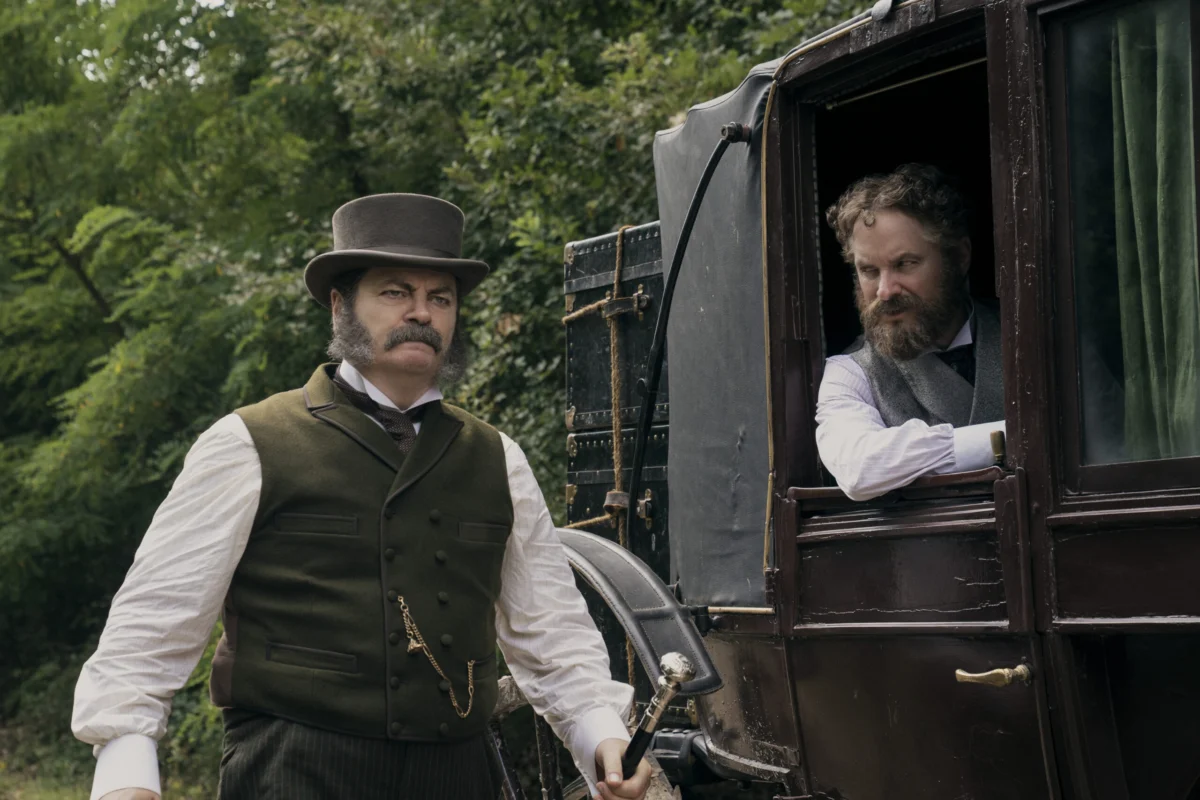
In the high-stakes landscape of prestige television, few transformations are as jarring—or as rewarding—as the one depicted in Netflix’s limited series Death by Lightning. At the center of this historical whirlwind is Nick Offerman, whose portrayal of the 21st President of the United States, Chester A. Arthur, has earned him a well-deserved Emmy nomination for Best Supporting Actor in a Limited Series. However, in a move that mirrors the humility of his character’s eventual redemption, Offerman’s favorite moment from the series is not one where he commands the room with a soaring oration. Instead, it is a scene defined by his own silence, a stinging physical blow, and the ferocious brilliance of his co-star, Betty Gilpin.
As part of IndieWire’s “My Favorite Scene” series, Offerman recently sat down to dissect the pivotal encounter between Vice President Arthur and Lucretia “Crete” Garfield. It is a moment he describes as Arthur’s “crucible,” a turning point that transitions the character from a corrupt political operative to a man capable of leading a grieving nation.
Main Facts: A Performance Defined by Generosity and Grit
The core of Offerman’s Emmy-nominated performance lies in his willingness to inhabit a character that is, by his own admission, a “fat, sinful hog of a man.” When executive producer and writer Mike Makowsky approached Offerman for the role, he noted that he had envisioned the actor as Arthur from the project’s inception. For Offerman, the appeal was not in playing a hero, but in navigating the profound moral arc of a man who discovers his conscience far too late.
Death by Lightning, produced by the formidable duo of David Benioff and D.B. Weiss (Game of Thrones) and directed by Matt Ross (Captain Fantastic), chronicles the brief, tragic presidency of James A. Garfield (played by Michael Shannon) and the subsequent rise of Chester A. Arthur. The series has been lauded for its "Deadwood-ification" of history—a stylistic choice that strips away the sterile, polite veneer often found in period dramas to reveal the filth, profanity, and raw ambition of the 19th-century American political machine.

Offerman’s chosen scene occurs in the wake of the assassination attempt on President Garfield. Arthur, a man who ascended to the Vice Presidency solely through the machinations of New York’s corrupt political "Stalwarts," finds himself paralyzed by guilt and incompetence. He returns to the White House in a state of physical and emotional disarray, seeking to resign. It is here that Betty Gilpin’s Lucretia Garfield delivers a "full-contact slap" that echoes through the halls of history, demanding that Arthur find the "shred of real nobility" buried beneath his layers of self-loathing.
Chronology: From the Gutters of New York to the Oval Office
To understand the weight of the scene Offerman highlights, one must trace the chronological descent and eventual ascent of Chester A. Arthur as depicted in the series.
The Era of Iniquity
The series introduces Arthur not as a statesman, but as a "snuffling" enforcer for Senator Roscoe Conkling (Shea Whigham). In the 1880s, the "Spoils System" was the law of the land, and Arthur was its primary beneficiary as the Collector of the Port of New York. Offerman portrays this version of Arthur with a corpulent, greasy charm—a man more concerned with the quality of his sausages and the loyalty of his political cronies than the welfare of the Republic.
The Unwanted Promotion
When James Garfield, a man of genuine intellect and reformist zeal, is unexpectedly nominated for President, Arthur is tacked onto the ticket as a peace offering to the Conkling faction. Arthur’s tenure as Vice President is characterized by shirking duties and maintaining a back-channel to his old boss, Conkling. However, the shooting of Garfield by Charles Guiteau (Matthew Macfadyen) shatters this comfortable corruption.

The White House Confrontation
The chronology of the specific scene Offerman selects finds Arthur at his absolute nadir. Having broken ties with Conkling in a fit of panicked morality, he arrives at the White House smelling of "horseshit" and sweat, having traveled in the back of a wagon. He is a man who wants to hide from the sun. When he encounters the First Lady and Secretary of State James G. Blaine (Bradley Whitford), he is a "simpering ninny," weeping and begging for divine punishment.
The Turning Point
The slap from Lucretia Garfield acts as a hard reset. Following this confrontation, the chronology of the show shifts. Arthur stops being a puppet. He begins to inhabit the presidency with a somber dignity, eventually championing the very civil service reforms that his former associates despised.
Supporting Data: The Craft of "Corpulent" Realism
Offerman’s performance is supported by significant technical and physical labor, which he credits for helping him find the character. To portray the "fat, sinful hog," Offerman underwent a physical transformation that involved gaining 20 pounds and wearing a full-body fat suit.
The Costume as Character
Offerman points to the specific detail of the 19th-century paper collars as a vital tool. By making the collar slightly too tight, the costume department created a "cleavage" of neck fat that visually communicated Arthur’s gluttony and lack of discipline. "That does so much work to say ‘corpulent,’" Offerman noted, highlighting how the physical discomfort of the wardrobe informed his slumped, heavy movements.

The "Deadwood" Influence
The series intentionally leans into the visceral reality of the 1880s. Offerman discusses the "Deadwood-ification" as a necessary antidote to the "fancy-pants" version of history. By including scenes of characters vomiting, farting, and using coarse language, the production creates a sense of "organic life." This realism extends to the physical acting; Offerman and Gilpin performed 12 "full-contact" slaps to ensure the scene felt authentic. Offerman, drawing on his theater background, explained the technique of leaving the jaw loose to create a "fleshy curtain" that absorbs the blow without causing injury, allowing for a realistic sound and reaction.
Official Responses: Collaboration and Directorial Vision
While the series has been a critical darling, Offerman expressed a touch of regret regarding its commercial "push," stating that he believes the various departments—from costume to production design—deserve the highest honors in the industry.
The Director’s Touch
Offerman was quick to praise director Matt Ross for his "generous" and "beautiful" approach. Ross, himself an accomplished actor, allowed for a rehearsal process that prioritized the chemistry between performers. This was particularly evident in the relationship between Offerman and Shea Whigham. Offerman described their dynamic as having a "Rosencrantz and Guildenstern quality," where the writing provided all the necessary subtext for their "political breakup."
A "Supportive" Supporting Actor
Offerman’s response to his own nomination is uncommonly humble. He admits to "not loving" his own performance in the chosen scene, preferring to highlight the work of Gilpin and Whitford. This self-effacement, however, is exactly why the performance works. By playing Arthur as a man who is consistently overshadowed by more powerful personalities—first Conkling, then Garfield, then even the First Lady—Offerman creates a vacuum that makes his eventual rise to leadership feel earned and surprising.

Implications: The Legacy of a "Decent President"
The implications of Offerman’s performance in Death by Lightning extend beyond the awards circuit. It serves as a profound exploration of the capacity for human change. Chester A. Arthur is often a forgotten footnote in American history, yet the series argues that his transformation was one of the most significant moral pivots in the history of the executive branch.
The End of the Spoils System
The real-world implication of Arthur’s "crucible moment" was the passage of the Pendleton Civil Service Reform Act. By portraying the raw, ugly reality of the system that created Arthur, the series makes his eventual betrayal of that system feel like a heroic act of treason against his own past.
The Evolution of Nick Offerman
For Offerman, this role marks a significant milestone in a career that has transitioned from the comedic stoicism of Ron Swanson (Parks and Recreation) to the heartbreaking vulnerability of Bill in The Last of Us, and now to the complex, groveling redemption of Chester A. Arthur. It cements his status as one of the most versatile character actors of his generation, capable of finding the "shred of nobility" in even the most unlikely of figures.
In choosing a scene where he is literally and figuratively slapped into awareness, Offerman has provided a masterclass in what it means to be a "supporting" actor. He doesn’t just support the plot; he supports the emotional truth of his co-stars, allowing their fire to light the way for his character’s salvation. Death by Lightning stands as a testament to the idea that history is not just made of dates and documents, but of "smelly ninnies" who, when pushed hard enough, choose to become men of honor.