Unearthing Universal Truths: "The Treasury of Folklore" Unites Global Myths in a Grand Compendium
FOR IMMEDIATE RELEASE
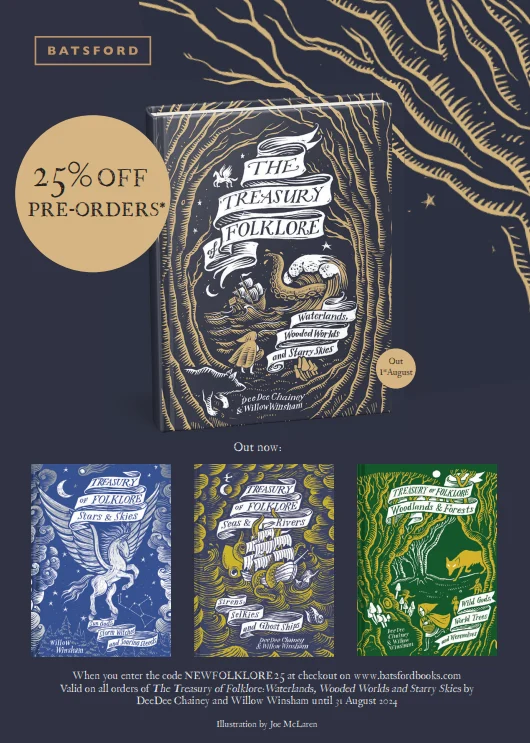
LONDON, UK – [Insert Current Date] – After nearly a decade of captivating readers with individual volumes, the acclaimed "Treasury of Folklore" series is set to release a magnificent single-volume compilation, "The Treasury of Folklore: Waterlands, Wooded Worlds and Starry Skies." This ambitious new compendium, launching on August 1, 2024, fulfills the authors’ original vision of a unified exploration of human beliefs, customs, and tales woven around the diverse landscapes of our world.
Main Facts: A Grand Vision Realized
The forthcoming release marks a significant milestone for the "Treasury of Folklore" series, bringing together the most cherished and insightful material from its three highly successful predecessors: Seas and Rivers, Trees and Woodlands, and Stars and Skies. This new, beautifully bound volume is not merely a reprinting but a carefully curated compendium, designed to offer readers a holistic journey through the shared human experience as illuminated by global folklore.
Authored by Dee Dee Chainey and Willow Winsham (implied authors through the original text’s "we"), and featuring the distinctive original illustrations of Joe McLaren, the compilation represents a profound exploration into how humans universally grapple with primal fears, dreams, and the vast mysteries of existence. From the deepest lochs to the highest celestial bodies, the book reveals a profound commonality in human storytelling, transcending geographical and cultural divides.
While the "Treasury of Folklore: Waterlands, Wooded Worlds and Starry Skies" contains no new textual material, it has been meticulously re-edited and structured to present a cohesive narrative. Its purpose is to serve as both a visually stunning addition to any collection and a potent catalyst for conversation and connection, drawing readers into a timeless dialogue with humanity’s collective imagination. The volume is described by its creators as a "hefty tome" – a testament to the richness of its content and the quality of its production, featuring beautiful cream paper and a striking cover design that elegantly unifies the themes of water, earth, and sky.
The compilation is now available for pre-order and promises to be a definitive collection for enthusiasts of mythology, anthropology, and the enduring power of human stories.
Chronology: From Digital Hashtag to Definitive Tome
The journey of "The Treasury of Folklore" series began almost ten years ago, sparked by a potent realization of the enduring power and global reach of folklore. The authors were profoundly inspired by the vibrant community and "overwhelming outpouring of folklore" witnessed through the #FolkloreThursday hashtag, a digital movement that underscored a widespread, fervent interest in traditional tales and beliefs. This online phenomenon provided the initial impetus, driving the creators to develop something tangible, "meaningful, lasting, that reflected the unifying universality of folklore across the globe."
Their initial, ambitious concept was to encapsulate all forms of physical landscapes and the folklore associated with them within a single book. However, as the research deepened and the narratives unfolded, it became abundantly clear that the sheer volume and richness of the material far "greatly surpassed what could be contained within a single book." This necessitated a strategic pivot, leading to the creation of the celebrated three-book series: Seas and Rivers, which delved into the mysteries of aquatic realms; Trees and Woodlands, exploring the sylvan spirits and ancient forests; and Stars and Skies, charting the myths and legends inspired by the celestial canopy.
The individual success of these three volumes was, in the authors’ own words, "both surprising and heartwarming." The positive reception from readers worldwide not only validated their initial efforts but also cemented the series’ reputation as a respected and beloved contribution to the study of folklore. This widespread appreciation underscored the universal appeal of these ancient stories and the human desire to connect with cultural heritage.
The idea of a compendium emerged as a natural progression, a suggestion that resonated deeply with the authors’ original aspirations. Recognizing a unique "opportunity to compile much of this folklore in one special volume," the decision was made to revisit the initial vision. The behind-the-scenes process was described as an intensive, reflective undertaking. It involved "reading through the words we already knew so well, with fresh eyes," a meticulous effort to discern what elements would best contribute to a cohesive, comprehensive single volume. This careful selection and arrangement aimed to "bring it all together in one volume that spans our shared landscapes across time and place," ensuring that the final "hefty tome" would not just be a collection, but a unified narrative celebrating the intricate tapestry of global human experience.

Supporting Data: Unpacking Universal Fears and Celestial Narratives
The core philosophy underpinning "The Treasury of Folklore" series is the profound discovery that, despite superficial differences in geography, culture, or customs, humans across the globe share fundamental experiences. The authors eloquently articulate this truth: "in so many ways, we are all inherently the same. We discovered that we, as humans, all share primal fears and dreams, no matter where we live, how we dress, or what we choose to name the monsters of our myths and legends." This compilation serves as a powerful testament to this shared humanity, presenting diverse tales that echo universal themes.
Waterlands: The Perilous Steeds of the Deep
The "Waterlands" section plunges into the depths, exploring the universal human fascination and fear of water, embodied by the mythical "water horse." These creatures, whether real or cautionary, tap into a primal dread of the unknown lurking beneath placid surfaces.
The Scottish kelpie is perhaps the most famous, a shape-shifting equine spirit often confused with the each-uisge. While both are water horses, the kelpie typically inhabits rivers, luring unwary travellers to a watery demise. The text highlights how kelpies can be seemingly tamed with a cross-marked bridle, yet their true, wild nature always reasserts itself, often dragging riders to their deaths. Intriguingly, it notes that a kelpie can be killed, traditionally by "red-hot iron" – a common weakness for many folkloric creatures. The enduring power of the kelpie in the Scottish imagination is strikingly demonstrated by the monumental 30-metre-tall sculptures near Falkirk and its continued presence in modern literature by authors like Lari Don and J.K. Rowling. Notably, England’s folklore appears to lack such prominent water horses, a curious regional variation.
Crossing the border into Wales, we encounter the Ceffyl Dwr, a staple of Welsh belief well into the 19th century. This spirit displayed regional variations: in the north, it was a violent shapeshifter, while in the south, it consistently appeared as an enchanting, small horse. Tales emphasize its incredible speed, covering vast distances before vanishing, leaving its hapless rider to drown. A peculiar exception granted immunity to clergymen of any creed, who could ride the Ceffyl Dwr unscathed, a fascinating glimpse into historical religious beliefs and social status.
Further north, Scandinavia introduces the bäckahäst or ‘brook horse,’ often sighted in foggy conditions. Described as majestic and luminous, it, too, beguiles riders before plunging them into the water. Children are frequently its victims in these tales, heightening the sense of peril. A popular anecdote recounts how a group of boys are saved when the last child mispronounces "Jesus Christ," invoking the bäckahäst’s aversion to the sacred name. Like the kelpie, the bäckahäst could also be put to work, sometimes through trickery. These diverse tales underscore a shared human caution against the deceptive beauty of nature and the dangers of unexplored territories.
Wooded Worlds: Guardians and Tricksters of the Forest
Venturing into the "verdant greenery of the forest," the compilation introduces "Lords of the Wild"—powerful spirits and creatures that embody humanity’s complex relationship with untamed nature, ranging from benevolent protectors to malevolent tricksters.
The Finnish forest god Tapio, also known as Metsähine or Hiisi, reigns as the king of the forest realm. He is depicted as tall and thin, clad in ermine fur or moss, with a mossy beard and bushy eyebrows, often likened to the "green man" figures of European folklore. He is both the personification and protector of the forest, with a gnarled tree-like back. Historically, hunters would seek his blessing, pledging respect for the woods and its creatures, believing Tapio could ensure a plentiful hunt or condemn them to empty-handed failure. His family includes his wife Mielikki (or Kuurikki when malevolent), and children Nyrikki and Tulikki, who assist hunters. The Estonian equivalent shares many traits, notably having only one eye, akin to the Norse god Odin. Tapio reflects a deep animistic respect for nature, where human survival depends on appeasing the forest’s guardian.
In Slavic folklore, the leshy (or leshii/lyeshy) stands as a tutelary spirit, protector of trees and animals, particularly wolves or bears, and hibernates in winter. Known by many names, often linking them to the woodsman or the Devil, leshies are shapeshifting entities, able to grow taller than trees or shrink to the size of grass. Their human forms are identifiable by missing eyelashes/brows, shoes worn on the wrong feet, or clothing wrapped in reverse. They are covered in wild hair, possess cloven feet, and some even have wings or tails. Leshies wield immense power, their bellowing winds terrorizing creatures. They are notorious tricksters, mimicking voices to lure people off paths, confusing them, and sometimes even tickling them to death. They can cause illness, abduct women and children, and curse farms, leading to annual cow sacrifices in some regions. Protection against a leshy includes prayers, offerings, or the specific act of turning one’s clothes inside out and shoes on the wrong feet – a common apotropaic ritual across fae folklore. Swearing or making the sign of the cross also banishes them. Summoning a leshy, however, involves a specific ritual of cutting young birch trees and forming a circle, calling out to the "grandfather of the forest." These tales highlight the dangers and sacredness of the wild, and the need for humans to navigate it with respect and caution.

Starry Skies: Celestial Narratives and Human Fate
Finally, the "Starry Skies" section turns our gaze upwards to the moon, exploring the myriad tales humans have woven around its luminous surface, particularly the recurring motif of "The Hare in the Moon." This universal image, where features like the Sea of Tranquillity are seen as the hare’s head and the Seas of Fertility and Nectar its ears, underscores humanity’s innate desire to find meaning and narratives in the celestial.
One prominent narrative comes from the Buddhist Sasa-Jātaka, where a benevolent hare, alongside its friends (an otter, jackal, and monkey), advocates for charity. When the deity Sakka, disguised as a beggar, tests them, the hare, having only grass, selflessly offers itself as food by leaping into a fire. For this ultimate act of faithfulness, Sakka saves the hare and enshrines its image in the moon for all eternity. Similar tales of a self-sacrificing hare appear in Sri Lankan and Japanese folklore, with variations in the divine figure (Buddha or the Man in the Moon) and the circumstances, but retaining the core theme of selfless giving rewarded by celestial honour. In Japan, this tale, featuring Tsuki no Usagi, is particularly popular, often recounted to children during the Harvest Moon and Mid-Autumn Festival in September.
A starkly contrasting narrative emerges from South African folklore, where the hare is portrayed as a mischievous, even destructive, figure responsible for human mortality. Here, the Moon sends Hare to deliver a message to humankind: that like the moon, they too would "die" (fade) only to return. However, the flighty Hare misdelivers the message, telling humans they would simply die, without the promise of return. Enraged, Moon attacks Hare with a hatchet, only succeeding in splitting its lip. In retaliation, Hare lashes out, scarring the Moon’s face – scars that, according to the tale, are still visible as the dark shapes on the moon today. This tale offers a powerful counterpoint, illustrating how different cultures interpret celestial phenomena not just as symbols of hope and sacrifice, but also as reflections of human folly and the origins of existential realities.
The consistency and artistry of Joe McLaren’s wonderful original illustrations are highlighted throughout the compilation. His evocative black-and-white engravings, such as the Kelpie rising from the waters, the contemplative Leshy on a fallen tree trunk, and the ethereal Hare held in the palm of a hand, serve as crucial visual anchors, breathing life into these ancient narratives and enhancing the reader’s immersive experience.
Official Responses: Authors’ Delight and Reader Connection
The authors’ personal reflections on the creation of this compendium are infused with a deep sense of accomplishment and gratitude. They confess to being "blown away by the end result" and "utterly thrilled to be able to share this beautifully bound volume." This sentiment stems from the realization of their initial, ambitious dream: to bring together the vast tapestry of global folklore into a single, cohesive volume.
Their heartfelt thanks extend to "each and every person who has bought and read these books," acknowledging the pivotal role of their audience in the series’ success. This appreciation underscores the communal nature of folklore itself, which thrives on being shared and remembered.
The physical attributes of the compendium are a source of particular pride for the creators. They enthusiastically describe the "beautifully bound volume" as a "hefty tome," praising its substantial size, the evocative cover that seamlessly integrates the themes of water, earth, and sky, and the luxurious "beautiful cream paper." These details speak to a commitment to quality that transcends mere content, aiming to create an artifact that is as tactilely pleasing as it is intellectually stimulating.
Ultimately, the authors envision "The Treasury of Folklore: Waterlands, Wooded Worlds and Starry Skies" as more than just a book. It is designed to be "a beautiful addition to any book case or coffee table, a conversation starter, a way to connect." This aspiration reinforces the book’s role as a bridge—connecting past with present, diverse cultures with shared humanity, and individuals with a wider world of myth and wonder.
Implications: Preserving Heritage and Fostering Global Empathy
The release of "The Treasury of Folklore: Waterlands, Wooded Worlds and Starry Skies" carries significant implications for cultural preservation, interdisciplinary study, and the promotion of global empathy. By consolidating the rich narratives from three distinct volumes into one accessible "hefty tome," the authors and publisher have created a powerful tool for safeguarding and celebrating diverse folklore traditions. This compilation ensures that these invaluable stories, which often serve as foundational texts for understanding human societies, are readily available to a broad audience, from casual readers to dedicated scholars.

The book’s central premise—the universality of human fears, dreams, and a shared awe for the natural world—has profound implications for fostering intercultural understanding. By demonstrating that societies across continents have conjured similar mythical creatures (like water horses) or found comparable meanings in celestial bodies (like the hare in the moon), the compendium highlights our fundamental interconnectedness. This shared imaginative landscape can serve as a potent reminder of our common humanity, encouraging empathy and breaking down perceived barriers between cultures. In an increasingly globalized world, such insights are invaluable for building bridges of understanding.
Furthermore, the enduring power of storytelling is vividly showcased within these pages. The continued resonance of tales about trickster spirits like the Leshy or protective deities like Tapio underscores humanity’s innate need for narrative to make sense of the world, to impart moral lessons, and to confront the unknown. The book serves as a testament to the timeless nature of myth, reminding us why these stories, passed down through generations, continue to captivate and instruct. It encourages readers to reflect on their own cultural narratives and to appreciate the unique ways different communities have articulated their relationship with their environment and the cosmos.
While the compilation consciously avoids introducing new material, its very existence solidifies the "Treasury of Folklore" series’ legacy. It establishes a definitive collection that can inspire future generations of folklorists, writers, and artists. Its potential educational value is immense, offering a rich resource for classrooms and personal study, sparking curiosity about anthropology, history, and comparative mythology. By presenting these tales in a beautifully produced volume, the book encourages a deeper appreciation for the aesthetic and intellectual richness of folkloric heritage.
In essence, "The Treasury of Folklore: Waterlands, Wooded Worlds and Starry Skies" is more than just a book; it is an invitation to embark on an epic journey through the collective human imagination. It prompts readers to look at their surroundings, both natural and celestial, with fresh, folkloric eyes, recognizing the echoes of ancient fears and dreams that still shape our modern world.
"The Treasury of Folklore: Waterlands, Wooded Worlds and Starry Skies" is available for pre-order now and will be released on August 1, 2024.
For a limited time, readers can receive 25% off their order at Batsford Books using the code NEWFOLKLORE25.
Contact:
[Placeholder for PR Contact Information – Not provided in original text]